Termite droppings
Drywood pellets compared with dampwood pellets, carpenter ant sawdust and powderpost beetle frass, with two checks you can make at home.
Visible piles of termite droppings in a house usually come from drywood termites. The pellets are hard, about 1 mm long and six-sided with ridges, collecting below holes under 2 mm wide 12. Subterranean termites do not push droppings out of the wood 3. Fibrous sawdust points to carpenter ants and flour-fine powder to powderpost beetles 45.
Drywood termites are unusual among termites in leaving their evidence in plain sight. Their fecal pellets, distinctive in shape, may be the first clue a building has them 6.
Perhaps you wiped a windowsill and found a little heap of what looks like coarse sand or ground pepper, with no insect in sight.
But several wood pests leave debris behind. A pile of genuine termite pellets can also sit in place long after the colony has died. Is it termite droppings at all, and if it is, are the termites still in the wood?
We set termite pellets beside the lookalikes described in extension bulletins from California, Florida, Texas, Missouri and Oregon.
What drywood termite pellets look like up close
Shape identifies them: drywood termite pellets are hexagonal in cross section 7, with six longitudinal flattened sides 6. Texas A&M describes them as blunt at one end and pointed at the other, with long dimples or flutes on each face that show under modest magnification 8.
They are small and uniform. Pellets of the western drywood termite (Incisitermes minor) average 0.98 mm long, against 0.87 mm for the West Indian drywood termite (Cryptotermes brevis) 1. Mississippi State treats an accumulation of small, uniform-sized, six-sided pellets as a sign of drywood termite activity 9.
To the naked eye a pile looks like fine grains of sand 10. UC IPM describes the pellets as larger, granular and almost pepperlike compared with beetle frass 5.
Color misleads: pellets of C. brevis can be cream, red or black 7. UF/IFAS entomologists found the color unaffected by time or by the color of the wood the termites eat, so it plays no part in identification 7.
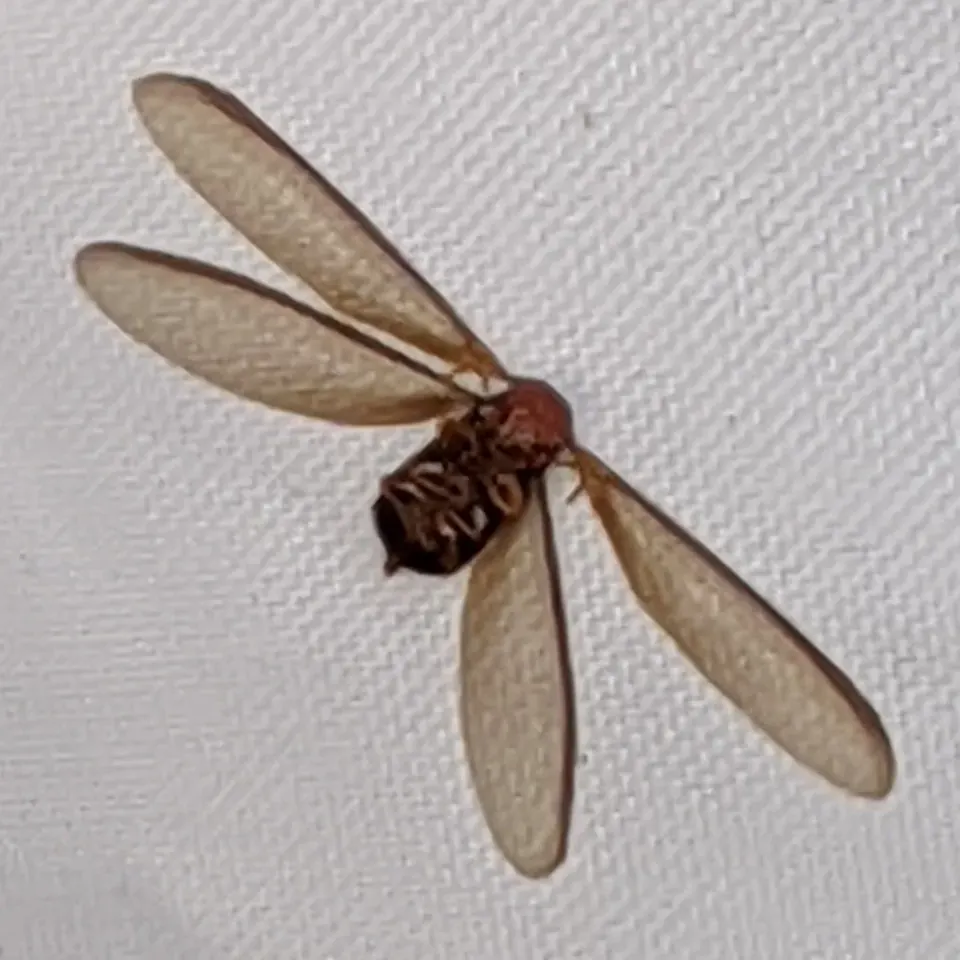
Where the pellets come from: kick-out holes
A drywood colony lives entirely inside the wood, with no soil contact or tubes 6. Its false workers (pseudergates) push pellets out through small kick-out holes, usually 1 to 2 mm in diameter 7.
The pile forms directly below the hole, or spreads into a scatter circle when the hole is high above the floor 7. Following a pile straight up usually leads to the hole and the infested board.
Inside, drywood termites cut across the grain in any direction, leaving smooth, sculptured chambers in both springwood and summerwood 810. Pellets fill some of the chambers 6. From the outside, the surface wood or paint may blister or peel 7.
The usual places are wood shielded from rain: structural lumber, furniture and other wooden items 7. UF/IFAS notes that drywood termites commonly infest furniture and are more often found in soffits and attics 11.
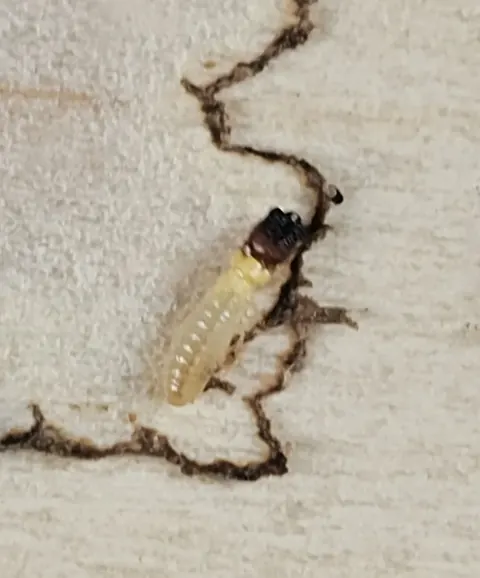
Where drywood pellets turn up, and where they are unlikely
Geography is the first filter, because drywood termites cause significant damage only in parts of the country 3. Their range covers the Atlantic coast south of Virginia, Florida, the Gulf Coast, the Mexican border and the Pacific Coast to just north of San Francisco 3.
In the Pacific Northwest the western drywood termite is uncommon; Oregon State gives tiny mounds of droppings as its sign there 12. Far outside that range, a pile of debris in a house is more likely the work of beetles or carpenter ants.
Inside a house, pellets accumulate on horizontal surfaces below the openings they fall from 6. Mississippi State's example is a pile on a floor or countertop 9. The next places to look are under wooden furniture and in attics, where drywood termites commonly live 11.
Do subterranean termites leave droppings?
They do, but not in piles. Subterranean termites do not reduce wood to powder or push wood particles outside, as beetles and carpenter ants do 3.
Their excrement stays in the galleries, as small grayish-brown specks in the excavated areas 3 or as soft fecal material plastered on tunnel walls in a pale, spotted coat 13.
That spotting sits alongside soil. Galleries that follow the grain and hold mud or dried dirt identify subterranean termite damage 139.
A pile of pellets on the floor therefore rules out subterranean termites as its source. Their evidence is the mud tube and the soil-lined gallery.
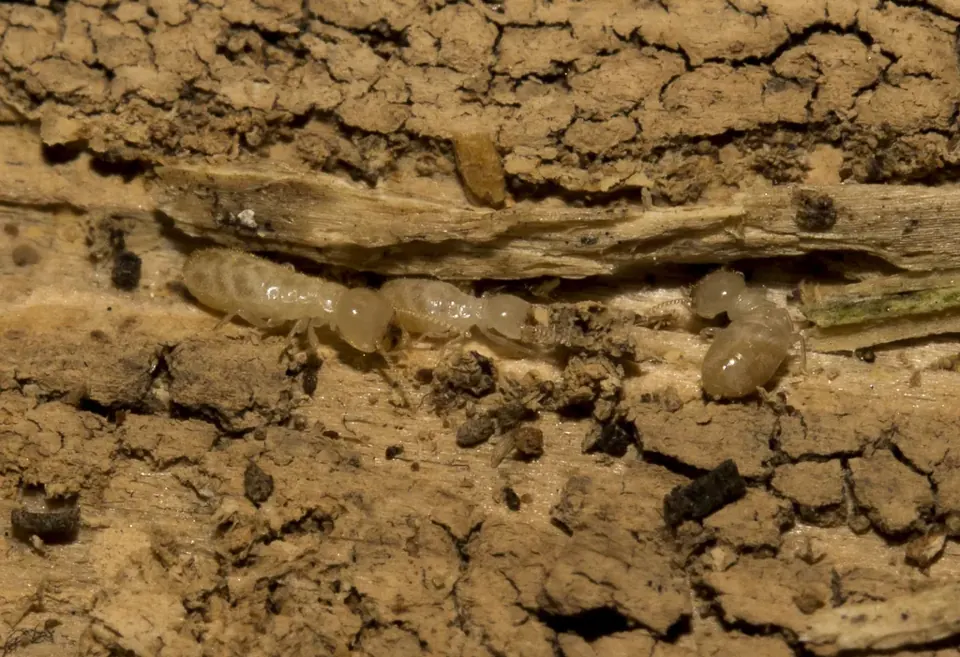
Dampwood termite pellets: bigger, rounded, no ridges
Dampwood termites also produce pellets. Those of Zootermopsis are elongated and rounded at both ends, like a football, without the clear longitudinal ridges of drywood pellets 2.
The setting gives them away as much as the shape. Dampwood termites live in wood that stays moist, often through soil contact or a water leak 6. In Florida's Neotermes, moisture in the galleries softens the pellets until they lose their shape and form clumps or paste 14.
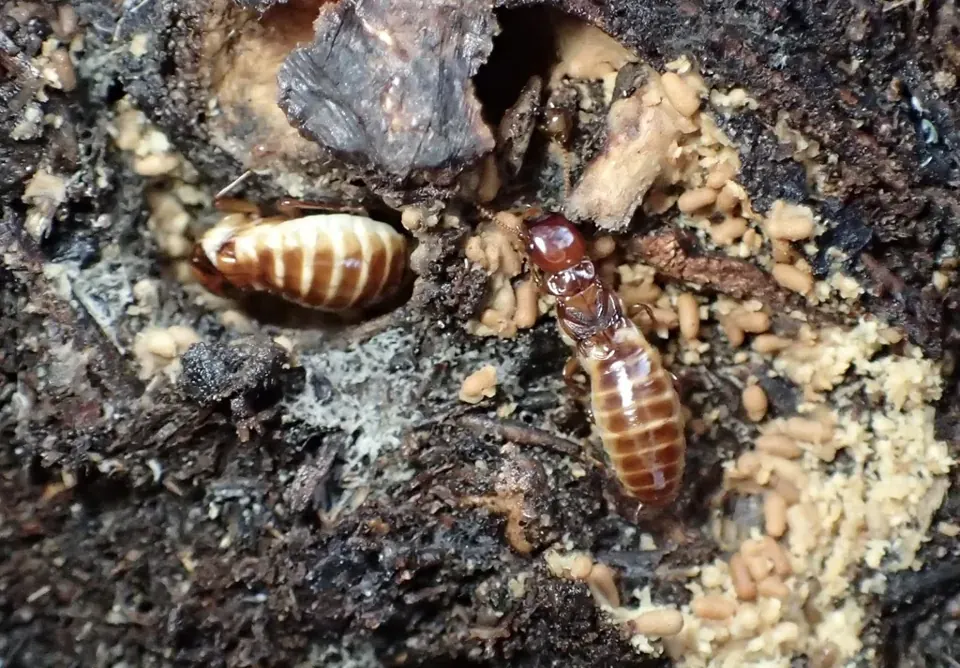
Termite pellets, ant sawdust and beetle powder side by side
Carpenter ants and three groups of wood-boring beetles also leave debris in houses. Each has a texture that sets it apart from termite pellets.
Carpenter ants. Carpenter ants excavate wood but do not eat it 15. They carry out shredded wood fragments, dead insects and other debris, which build up in cone-shaped piles beneath their nest openings 15. UC IPM calls this sawdust fibrous, in contrast with the six-sided pellets of drywood termites 4.
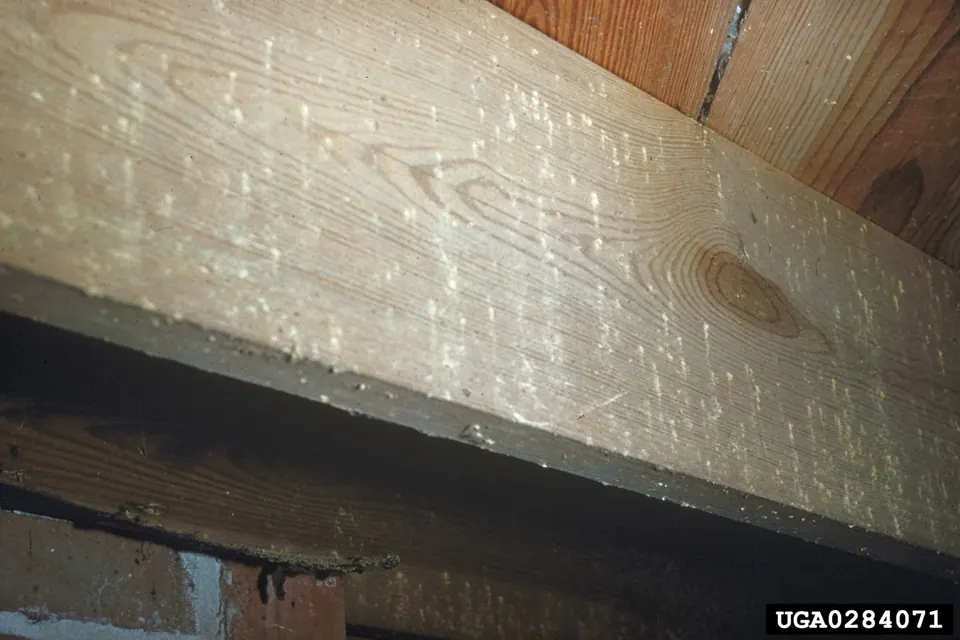
Powderpost beetles (Lyctinae). Their frass is a fine powder with the consistency of baking flour or talcum powder 5. It sifts out readily and contains no pellets 16. The round exit holes measure about 1/32 to 1/16 inch (0.8 to 1.6 mm) 17.
Deathwatch and furniture beetles (Anobiidae). These do make pellets, elongate or bun-shaped 16. They are smaller than drywood termite pellets and give the frass a gritty feel 5. Exit holes run about 1/16 to 1/8 inch 17.
False powderpost beetles (Bostrichidae). Their frass is coarse, like powdered borax soap, and packed so tightly into the galleries that it is hard to dislodge 5. Few if any pellets appear in it 16.
Control measures for carpenter ants differ greatly from those for termites 15. The beetles that pass for termites are told apart by their round exit holes as well as their frass 5.
Four checks you can make at home
UC IPM uses two quick tests to separate wood-boring beetles 5. With a hand lens and a photo added, they cover the common debris types.
- Look at the grains. Under a hand lens or a phone macro, termite pellets show flat faces and ridges 8. Fibers, wood splinters or insect legs point to carpenter ants 15.
- Rub the frass between your fingers. Lyctine powder feels like talcum powder and anobiid frass feels gritty. Bostrichid frass is the grittiest of the three 5.
- Try a ballpoint pen in the hole. Only the tip of a click-type pen fits a powderpost beetle hole. The tip and part of the angled face fit an anobiid hole. The whole point usually fits a bostrichid hole 5.
- Photograph the pile with a coin beside it. A scale object makes size readable 18.
Are the droppings old or new?
A pile of pellets shows that drywood termites were present at some point. UC IPM notes that pellets alone cannot show whether the infestation is still active or how far it extends 2.
Old pellets can be shaken loose from abandoned galleries by building movement or vibration 72. The standard test is to clean up the pellets around a kick-out hole and look again a few days later for new ones 2.
The same logic is used after treatment. UF/IFAS entomologists recommend removing all pellets and wings after a drywood treatment; new and growing piles afterward typically indicate that the treatment failed 7.
Beetle frass follows a similar rule. Powder alone does not prove an active beetle infestation, but frass that is bright and light-colored, like freshly sawn wood, indicates one 19.
What termite pellets mean for treatment
Drywood termites need treatments that reach into the wood. Soil termiticides and baits are designed for subterranean termites and do not apply to drywood termites 11.
The choices fall into two groups. Whole-structure treatments, fumigation or heat, treat every infestation at once, including hidden ones 2. Localized treatments, such as injecting insecticide into galleries or replacing a board, depend on finding every infested piece 2.
UF/IFAS lists the common options as replacing infested trim, removing infested furniture, spot treatment after a thorough inspection, and fumigation, which it rates as highly effective 11. UC IPM does not recommend do-it-yourself treatment, since products for drywood termites are not available to homeowners 2.
Swarmers are what identify the species: Texas A&M notes that the wings are needed for proper identification of drywood termites 8. Labs such as UF/IFAS in Fort Lauderdale offer free termite identification 20. The treatment options for drywood termites follow from that result.
Questions
What do termite droppings look like?
Drywood termite droppings are hard pellets about 1 mm long, six-sided in cross section with ridges along their length 16. They collect in small piles that look like coarse sand or ground pepper 105.
Do subterranean termites leave droppings?
Not as visible piles. Subterranean termites do not push particles out of the wood; their excrement stays inside the galleries as small grayish-brown specks mixed with soil 3.
I found termite droppings but no termites. Are they gone?
Not necessarily. Pellets alone cannot show whether a colony is active, so the usual check is to sweep them up and look for new pellets a few days later 2.
What color are termite droppings?
Drywood pellets can be cream, red or black. UF/IFAS entomologists found the color is not set by the color of the wood being eaten, so color does not identify them 7.
Sources
- Cabrera, B. J., and R. H. Scheffrahn. Western Drywood Termite, Incisitermes minor. UF/IFAS EDIS EENY248 (IN526). Original November 2001; revised December 2005; reviewed February 2021. ask.ifas.ufl.edu
- Lewis, V. R., A. M. Sutherland, and M. I. Haverty. Pest Notes: Drywood Termites. UC ANR Publication 7440. UC Statewide IPM Program. Updated 08/2014. ipm.ucanr.edu
- Peterson, C., T. L. Wagner, J. E. Mulrooney, and T. G. Shelton. Subterranean Termites: Their Prevention and Control in Buildings. USDA Forest Service, Home and Garden Bulletin 64. Revised October 2006. research.fs.usda.gov
- Klotz, S. A., L. D. Hansen, and M. K. Rust. Pest Notes: Carpenter Ants. UC ANR Publication 7416. UC Statewide IPM Program. Updated 08/2009. ipm.ucanr.edu
- Lewis, V. R., and S. J. Seybold. Pest Notes: Wood-Boring Beetles in Homes. UC ANR Publication 7418. UC Statewide IPM Program. Updated 06/2010. ipm.ucanr.edu
- Lewis, V. R., M. I. Haverty, and A. M. Sutherland. Pest Notes: Subterranean and Other Termites. UC ANR Publication 7415. UC Statewide IPM Program. Updated 05/2014. ipm.ucanr.edu
- Gordon, J. M., R. H. Scheffrahn, and N.-Y. Su. West Indian Drywood Termite, Cryptotermes brevis. UF/IFAS EDIS EENY-79 (IN236). Original April 1999; revised December 2025. doi:10.32473/EDIS-in236-2020. ask.ifas.ufl.edu
- Texas A&M University, Urban and Structural Entomology Program. Drywood Termites (web page). Year not stated. urbanentomology.tamu.edu
- Mississippi State University Extension Service, Dept. of Entomology. Signs of Termite Infestation. Year not stated. extension.msstate.edu
- University of Hawaii, CTAHR Termite Project. Drywood Termites vs. Subterranean Termites (public handout, PDF). Year not stated. www3.ctahr.hawaii.edu
- Oi, F. M., J. Davis, J. McConnell, J. Corbus, N. Nelson, and M. Atkinson. Termite Prevention and Control. UF/IFAS Extension ENY-2044 (IN1277). Original March 2020; revised December 2023. ask.ifas.ufl.edu
- Oregon State University Extension. Solve Pest Problems: Termites. Year not stated. solvepestproblems.oregonstate.edu
- Texas A&M University, Urban and Structural Entomology Program. Native Subterranean Termites, Reticulitermes sp. (web page). Year not stated. urbanentomology.tamu.edu
- Scheffrahn, R. H., and N.-Y. Su. Florida Dampwood Termites, Neotermes castaneus, N. jouteli, and N. luykxi. UF/IFAS EDIS EENY122 (IN279). Original January 2000; revised December 2005; reviewed February 2021. ask.ifas.ufl.edu
- Brown, W., and R. E. Gold. Carpenter Ants. Texas AgriLife Extension Service, E-412 (dated 12-11). agrilifeextension.tamu.edu
- Houseman, R. M. (reviser). Wood-Boring Beetles. University of Missouri Extension G7422. Reviewed June 2010 and September 2017. extension.missouri.edu
- Benson, E. P., and P. A. Zungoli. Wood-Boring Beetles in Houses. Clemson University Home and Garden Information Center, HGIC 2417. Originally published January 2001. hgic.clemson.edu
- LSU AgCenter, LSU Department of Entomology, and Louisiana State Arthropod Museum. Insect Identification Services. LSU AgCenter Publication 1838. Year not stated. www.lsuagcenter.com
- DeAngelis, J. Preventing and Controlling Powderpost Beetles in and around the Home. Pacific Northwest Extension PNW 326 (reprinted July 1995). entomology.oregonstate.edu
- UF/IFAS Fort Lauderdale Research and Education Center. Send Samples (Termites in Florida). Last modified June 15, 2026. flrec.ifas.ufl.edu