Dampwood termites
Zootermopsis on the West Coast, Neotermes in Florida and the desert dampwood termite of the Southwest.
Dampwood termites nest in moist, decaying wood and do not build mud tubes 1. The Pacific and Nevada dampwood termites live in the West 1; Florida has three Neotermes species 2. An infestation marks a water problem such as a roof leak, wood touching soil or sprinkler spray 2. Drying the infested area is usually enough to control them 3.
In forests, dampwood termites live in moist stumps and fallen trees, where their feeding helps break down dead wood 4.
They are also among the largest termites in the country. Winged Pacific dampwood termites reach about 1 inch long 5, while Florida's Neotermes are the largest termites in the eastern United States 2.
Finding an insect that size in a crawl space, or a pile of large pellets under a leaking deck, is unsettling.
But a large termite does not have to mean a large treatment bill. So are these termites the problem, or the symptom of one?
We read the Pacific Northwest, California and Florida extension publications on dampwood termites to find out.
Which dampwood termites live in the United States?
Dampwood termites are limited to the Pacific Coast, the desert Southwest and southern Florida 6.
Pacific and Nevada dampwood termites
The Pacific dampwood termite (Zootermopsis angusticollis) 7 ranges from British Columbia south to Baja California 1.
In Oregon it is caramel-colored to dark brown, with workers about 1/2 inch and soldiers about 3/4 inch long 5. Washington State University describes its winged forms as orange-brown and about 3/4 inch long including the wings 8.
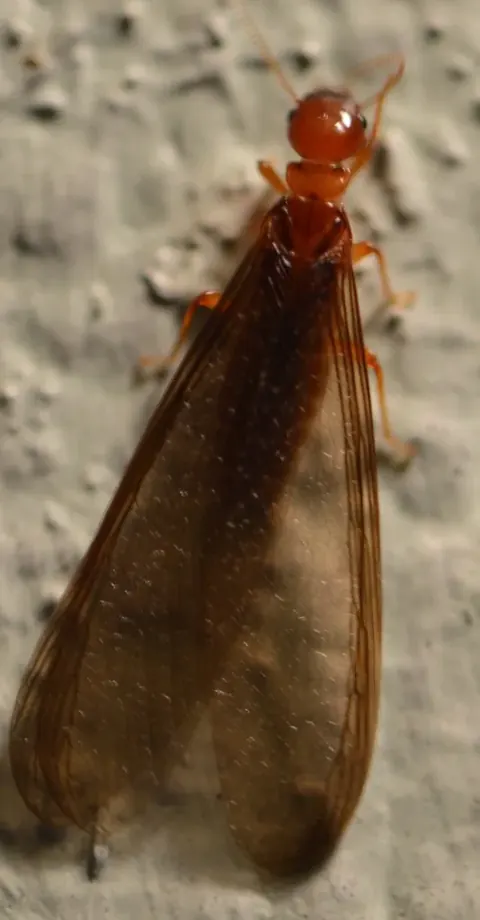
The Nevada dampwood termite (Z. nevadensis) 9 is darker and smaller, with winged forms usually under 20 mm 1. It tolerates cooler, drier habitats than its Pacific relative and lives at altitudes up to about 1,800 meters 1. Its range runs from southern British Columbia to Idaho and northern California 1.
In California, both species are common in central and northern coastal areas 10. They favor cool, humid places along the coast and in the forests of the Coast Range, the Cascades and the Sierra Nevada 10.
In the wild, Zootermopsis lives in dead trees, stumps and logs, especially conifers softened by fungal rot 1. The colony has no true worker caste; immature soldiers and reproductives do the work 1. Zootermopsis belongs to the family Archotermopsidae 11, which older sources call Termopsidae 1.
Florida dampwood termites
Florida has three Neotermes species: N. castaneus, N. jouteli and N. luykxi 2. They live in subtropical woodlands, mangroves and urban settings of the coastal peninsula and the Keys 2. In the United States and its Caribbean territories, Neotermes are endemic to Florida, Hawaii, Puerto Rico and the Virgin Islands 2.
Unlike the western dampwood termites, Neotermes belong to the drywood family, Kalotermitidae 2. UF/IFAS has also called them "southern dampwood termites," to avoid confusion with an unrelated subterranean species sometimes given the Florida dampwood name 2.
N. castaneus prefers living trees. Colonies can live in trees and palms for years or even decades before anyone notices them 2.
The termites feed on dead wood at the center of the tree and avoid the living layer beneath the bark 2. Galleries can weaken trunks and branches, but the overall health of the tree is usually not directly affected 2. Exposed galleries full of live N. castaneus give off a distinctive fecal odor 2.
Desert dampwood termite
The desert dampwood termite (Paraneotermes simplicicornis) ranges from southern California to Texas 12. Despite its name, it is classified in the drywood family 12.
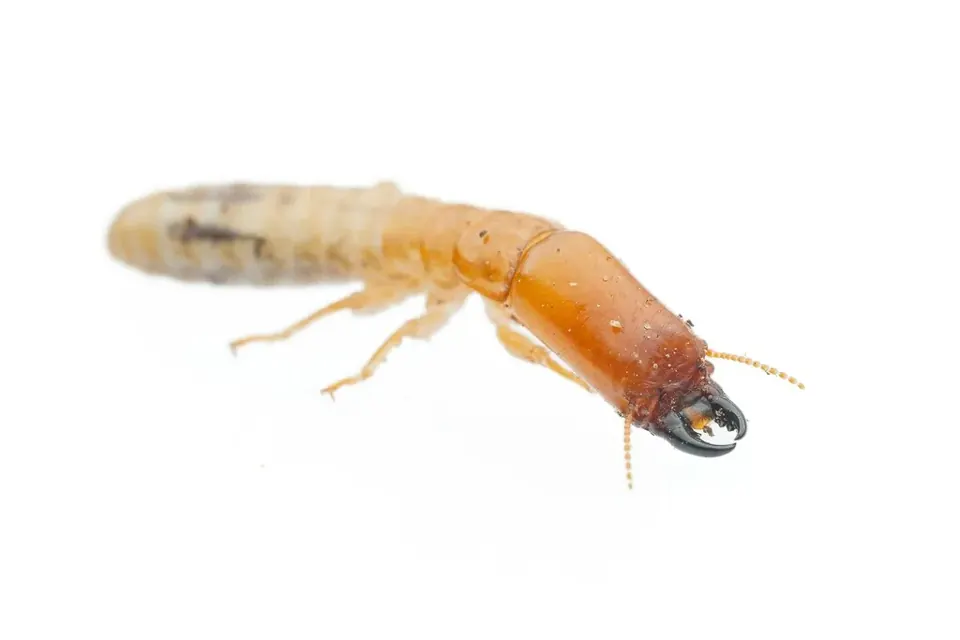
It attacks moist wood below ground, including untreated poles and fence posts 12. It also feeds on living desert shrubs and young citrus trees, using their sap for moisture 12. Its colonies are small, rarely more than about 1,400 individuals 12. It is rarely found in homes; when it is, the wood is moist or wet, usually in baseboards and door frames 12.
Telling a dampwood termite from drywood and subterranean termites
Size is the first clue in the West. Dampwood swarmers are larger than western drywood swarmers and fly to lights at dark 10.
Zootermopsis adults have three or four heavy veins along the front edge of the wing, no ocelli and no fontanelle 1. Their soldiers have toothed mandibles 1. Pacific dampwood termite soldiers reach 15 to 20 mm, with a dark brown head whose sides curve inward; Nevada dampwood soldiers have straight, parallel head sides 1.
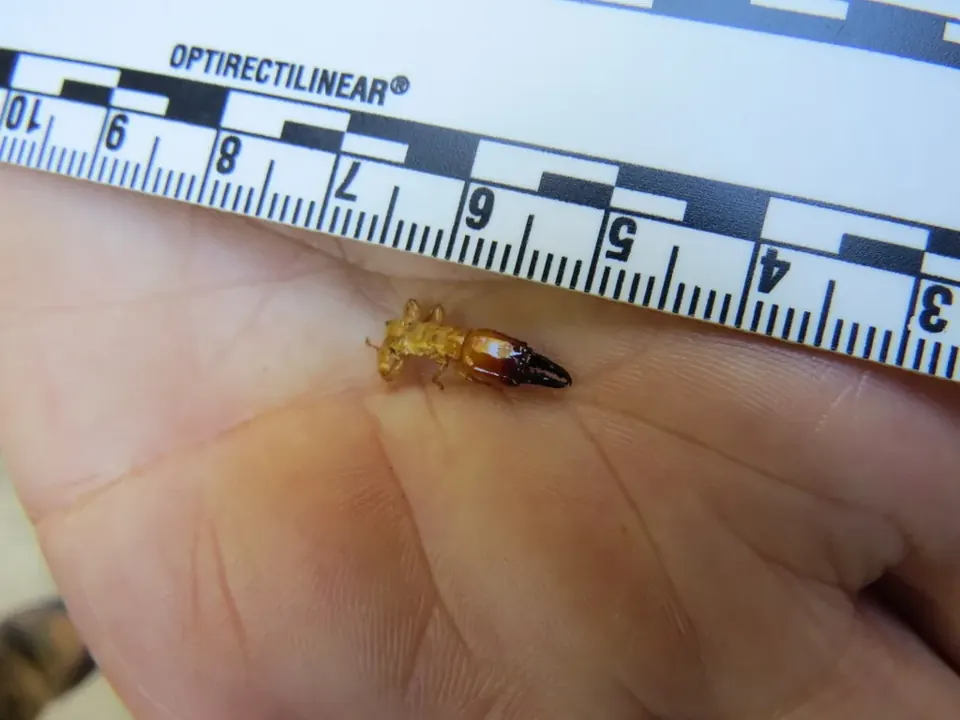
Neotermes alates carry five enlarged, pigmented veins on each fore wing, including an enlarged median vein that separates them from all other Florida termites 2. The soldiers are 8.5 to 13.5 mm long, with a pronotum as wide as the head 2.
The evidence differs too:
- No mud tubes. Zootermopsis does not tunnel through soil or build shelter tubes 1.
- Rounded pellets. Zootermopsis pellets are rounded at both ends and elongated, without the clear lengthwise ridges of drywood pellets 10.
- Clumped pellets in Florida. In wet Neotermes galleries, pellets lose their shape and form clumps or paste, more so as moisture rises 2.
- Large, open galleries. Dampwood termites hollow out large galleries inside moist or decayed wood 4.
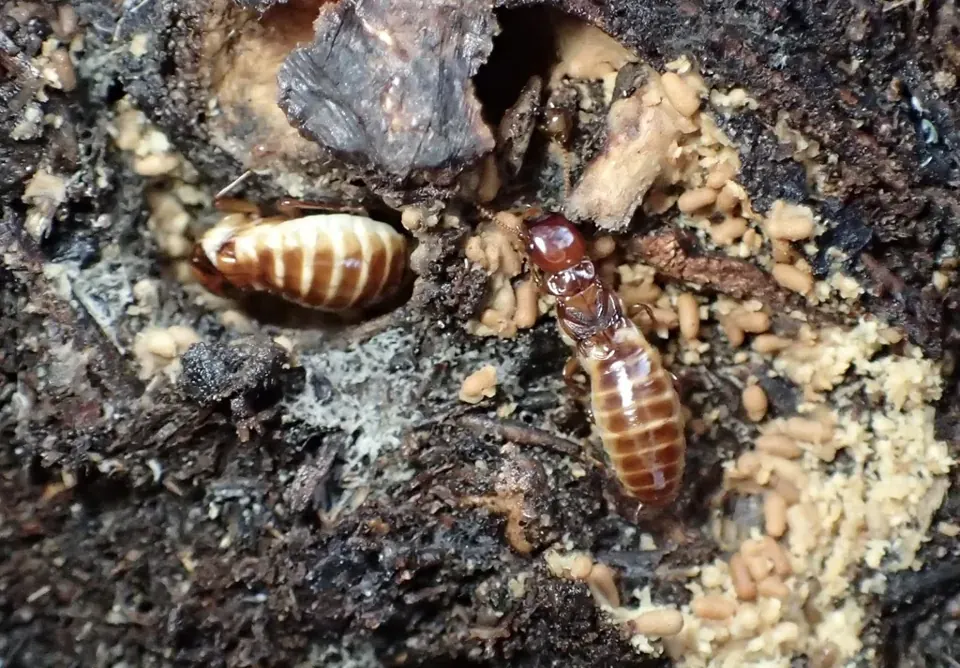
Colonies stay modest: Neotermes colonies can reach several thousand individuals, with gallery systems extending many meters into the wood 2.
How a new colony gets started
The start of a colony explains where dampwood termites turn up. After a flight, a male and female Neotermes pair shed their wings and look for a nest site 2. Typical sites are a crevice in a damp log, an untreated fence post, a pruning scar or a hole in a living tree 2.
The pair crawls in and seals the entrance with fecal material 2. A few weeks after mating the queen lays her first eggs; the first soldiers appear over the next few years 2. Only when the colony numbers in the hundreds does it produce its first winged swarmers 2.
Because a new colony takes years to produce swarmers, drying, removing or replacing damp wood early leaves arriving pairs fewer places to settle.
When dampwood termites swarm, and what an indoor sighting means
Pacific dampwood termites swarm in late summer or fall 5, especially after rain in Washington 8. In British Columbia they fly on warm evenings from July to September and often emerge from beach logs 1. In California, Zootermopsis swarms in summer and fall and is attracted to lights at dark 10.
In Florida, N. jouteli and N. luykxi tend to fly in late spring or summer 2. N. castaneus has peak flights in late fall or early winter 2. All three fly at dusk or at night and are drawn to porch lights, indoor lights and screens 2.
In Arizona, the desert dampwood termite flies at dusk from late May through September, often the evening after a strong summer rain 12.
Oregon State University Extension treats flying dampwood termites as no cause for alarm 5. In Florida, indoor Neotermes alates usually come from a yard tree or woodland colony and are unlikely to find the moist wood they need 2.
Moisture is the cause: where to look
Structural infestations of dampwood termites are tied to sources of free water 2. Their presence is a sign of a moisture problem or wood decay in the structure 4. Because the same conditions favor fungal decay and subterranean termites, correcting them protects the house against all three 2.
Common sources to check:
- Wood in contact with soil, such as posts, siding, steps and form boards left from construction 28.
- Roof and deck leaks 10.
- Siding or trim wetted by sprinklers or rain 2.
- Plumbing leaks and air conditioner drain lines that wet the structure 3.
- Crawl spaces without good ventilation or a vapor barrier 8.
- Pruning scars, tree holes and damp logs near the house, where Neotermes pairs start new colonies 2.
The fix: drying, replacing wood, and when chemicals help
Drying the infested area is usually enough to get rid of dampwood termites, so they rarely need the professional treatments used on other groups 3. That can mean fixing roof and plumbing leaks, provided the wood is not too decomposed 3. Replacing damaged wood and preventing new moisture are also effective 3.
Once the moisture source is removed, a Neotermes colony gradually declines and dies from drying out 2.
Chemicals are a backup for untreated wood that cannot be separated from its moisture source. Borate salts such as disodium octaborate tetrahydrate dissolve in water, so they are drawn into the wet, infested wood 2. Borates are toxic to plants, so they should not be used on live plants 3. Galleries in trees or structural members can also be injected with insecticides labeled for the site 2.
Wood pressure-treated with chromated copper arsenate (CCA) resists infestation 2. In Washington, pesticides are rarely needed for this group at all 8.
Waiting still has a cost: dampwood termites are minor pests, but wood damage can become severe after several years if an infestation is left alone 2. When the termites are inside the structure, Oregon State University Extension recommends leaving control to professional pest controllers 5.
Questions
Are dampwood termites dangerous to a house?
They are minor structural pests that cause less costly damage than drywood or subterranean termites 10. Left alone for several years, though, an infestation can do severe damage 2.
How do you get rid of dampwood termites?
Drying the infested area is usually enough, combined with fixing leaks and replacing damaged wood 3. A borate wood treatment or a direct insecticide injection is an option where wet wood cannot be removed 2.
Can dampwood termites live in dry wood?
Only near a moisture source. Florida Neotermes colonies can extend several meters into sound dry wood, but they decline and die once the moisture source is removed 2.
Sources
- Cannings, R. A., and G. G. E. Scudder. Families of Isoptera of British Columbia. In: Klinkenberg, B. (ed.) 2023. E-Fauna BC: Electronic Atlas of the Fauna of British Columbia. Dept. of Geography, University of British Columbia. linnet.geog.ubc.ca
- Scheffrahn, R. H., and N.-Y. Su. Florida Dampwood Termites, Neotermes castaneus, N. jouteli, and N. luykxi. UF/IFAS EDIS EENY122 (IN279). Original January 2000; revised December 2005; reviewed February 2021. ask.ifas.ufl.edu
- Oi, F. M., J. Davis, J. McConnell, J. Corbus, N. Nelson, and M. Atkinson. Termite Prevention and Control. UF/IFAS Extension ENY-2044 (IN1277). Original March 2020; revised December 2023. ask.ifas.ufl.edu
- Lewis, V. R., M. I. Haverty, and A. M. Sutherland. Pest Notes: Subterranean and Other Termites. UC ANR Publication 7415. UC Statewide IPM Program. Updated 05/2014. ipm.ucanr.edu
- Oregon State University Extension. Solve Pest Problems: Termites. Year not stated. solvepestproblems.oregonstate.edu
- Peterson, C., T. L. Wagner, J. E. Mulrooney, and T. G. Shelton. Subterranean Termites: Their Prevention and Control in Buildings. USDA Forest Service, Home and Garden Bulletin 64. Revised October 2006. research.fs.usda.gov
- Entomological Society of America. Common Names of Insects Database (search 'termite'). Accessed 2026-11-29. entsoc.org
- Washington State University, Pestsense. Termites (fact sheet). Year not stated. pestsense.cahnrs.wsu.edu
- UC Statewide IPM Program. Image record I-IS-ZNEV-CO.001: Nevada dampwood termite, Zootermopsis nevadensis (worker, soldier, nymph, swarmer). Credit: Robin L. Tabuchi. Year not stated. ipm.ucanr.edu
- Lewis, V. R., A. M. Sutherland, and M. I. Haverty. Pest Notes: Drywood Termites. UC ANR Publication 7440. UC Statewide IPM Program. Updated 08/2014. ipm.ucanr.edu
- Hellemans, S., M. M. Rocha, M. Wang, et al. (46 authors). 2024. Genomic data provide insights into the classification of extant termites. Nature Communications 15. doi:10.1038/s41467-024-51028-y. www.nature.com
- Baker, P. B., and R. J. Marchosky, Jr. Arizona Termites of Economic Importance. University of Arizona Cooperative Extension AZ1369. June 2005. extension.arizona.edu