Bugs that look like termites
Each lookalike with the single character that rules it in or out, drawn from university extension sources.
Common termite lookalikes are winged ants, carpenter ants, acrobat ants, powderpost beetles and booklice. Each fails one simple check. Ants give themselves away with elbowed antennae and a pinched waist 1. On a beetle, hard wing covers meet in a line down the back 2. Booklice carry long, threadlike antennae instead of beaded ones 3. Fungal wood rot can also pass for termite damage 4.
Termites have a short list of features that their common lookalikes do not share, which makes ruling them out quicker than it sounds. The lookalikes turn up in the same places, though: on windowsills, in damp bathrooms and in old wood 53.
Perhaps you found tiny pale bugs near the bathtub or a few winged insects dead on a sill. If so, the word "termite" probably came to mind first.
But the name you give the insect decides who you call and what you spend. Mississippi State University Extension puts professional termite treatment at around a thousand dollars or more 6, so a wrong name can be an expensive one.
So is the bug in front of you a termite, or something that only looks like one? We collected the lookalikes described in extension sources, each with the one check that separates it from a termite.
The termite baseline every lookalike fails
Every termite has moniliform antennae: straight and built from bead-like segments 7. The body runs straight back from the head with no pinched waist 1. A winged termite has four wings of about the same size and appearance 8.
Termites are also soft-bodied and light-colored, while ants are generally hard-bodied and dark 9. Each lookalike below breaks at least one of these rules, which gives it a deciding check.
Winged ants: look for the elbow in the antenna
University of Arizona Extension notes that winged ants are often mistaken for termite alates 10. The two often swarm at about the same time of year 4.
Deciding check: ant antennae are bent, like an elbow, while termite antennae are straight and beaded 8. A pinched waist and front wings longer than the hind wings confirm an ant 1, the same characters that separate flying ants from termites. Color will not help here, since ant swarmers range from light tan to black, overlapping both dark and pale termite swarmers 6.
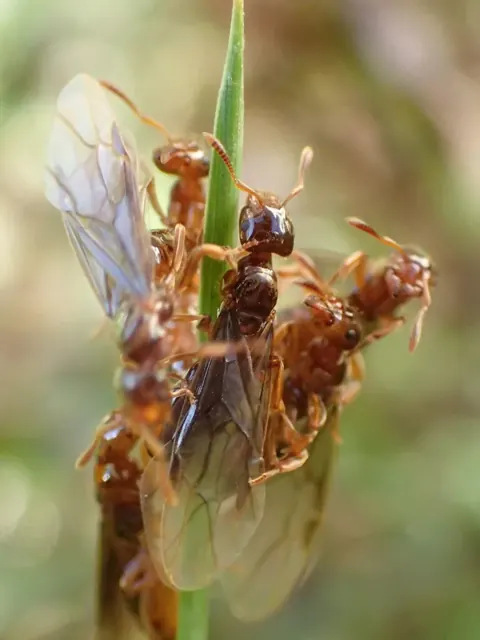
Several common ants swarm around houses. Pavement ants typically swarm in spring after rain and can swarm indoors 11. They nest under foundations and enter through cracks in concrete, so an indoor swarm can come from a nest under the slab rather than from the wood 11. Fire ants swarm from spring through late fall, especially a day or two after rain that follows a dry spell 12.
Carpenter ants: one node on the waist and coarse sawdust
Carpenter ants get mistaken for termites because they live in wood, which they hollow out for nests but do not eat 13.
Deciding check: a carpenter ant has a single node on its narrow waist and an evenly rounded thorax seen from the side 13. Termites have no waist at all.
Their damage can still be real. UC IPM notes that large carpenter ant colonies often start nests in water-damaged or decayed wood, then expand into sound wood and weaken the structure 14.
The debris confirms which insect you have. Carpenter ants push out coarse, fibrous sawdust mixed with dead insects, which piles into cones below small openings 1314. Subterranean termites push nothing out of the wood 15, one of several differences in debris and galleries between carpenter ants and termites.
Acrobat ants: the heart-shaped abdomen
Acrobat ants are often confused with carpenter ants, because both may nest in dead wood 13. Finding small ants in rotting wood can also suggest termites.
Deciding check: the abdomen of an acrobat ant is heart-shaped 13. The insect is also smaller than a carpenter ant, about 1/8 to 3/8 inch long 13.
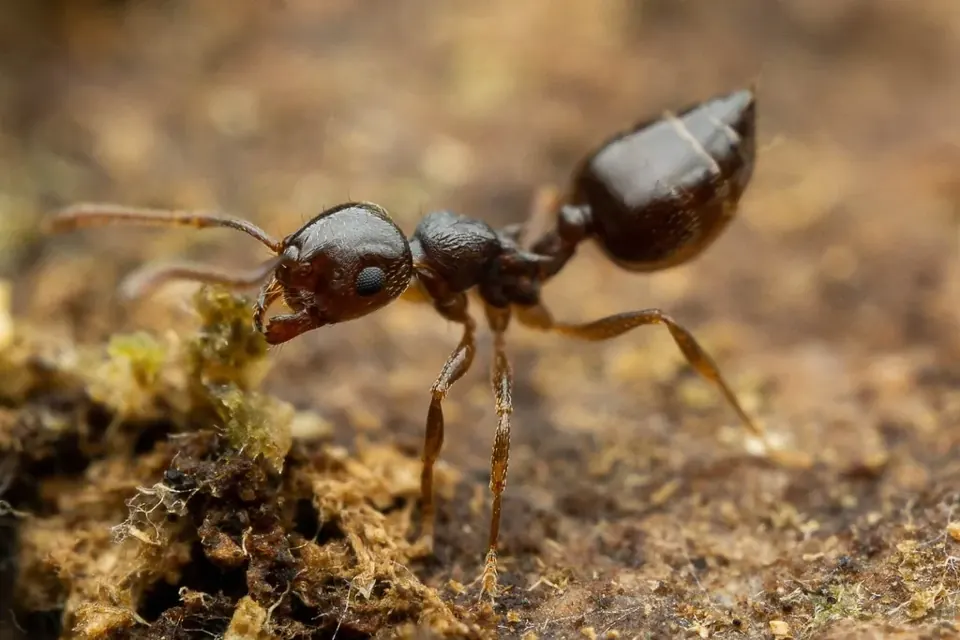
Like other ants, acrobat ants have elbowed antennae and a narrow waist. Neither feature occurs in termites 1.
Powderpost beetles: hard wing covers and flour-fine powder
Powderpost beetles are wood borers whose larvae feed inside the wood and do most of the damage 5. The adults fly toward light, so dead beetles collect on windowsills 5, exactly where termite swarmers end up 16.
Deciding check on the insect: a beetle's hardened front wings, the elytra, meet in a straight line down the middle of its back 2. Underneath sit the membranous hind wings 2. Termites have no wing covers.
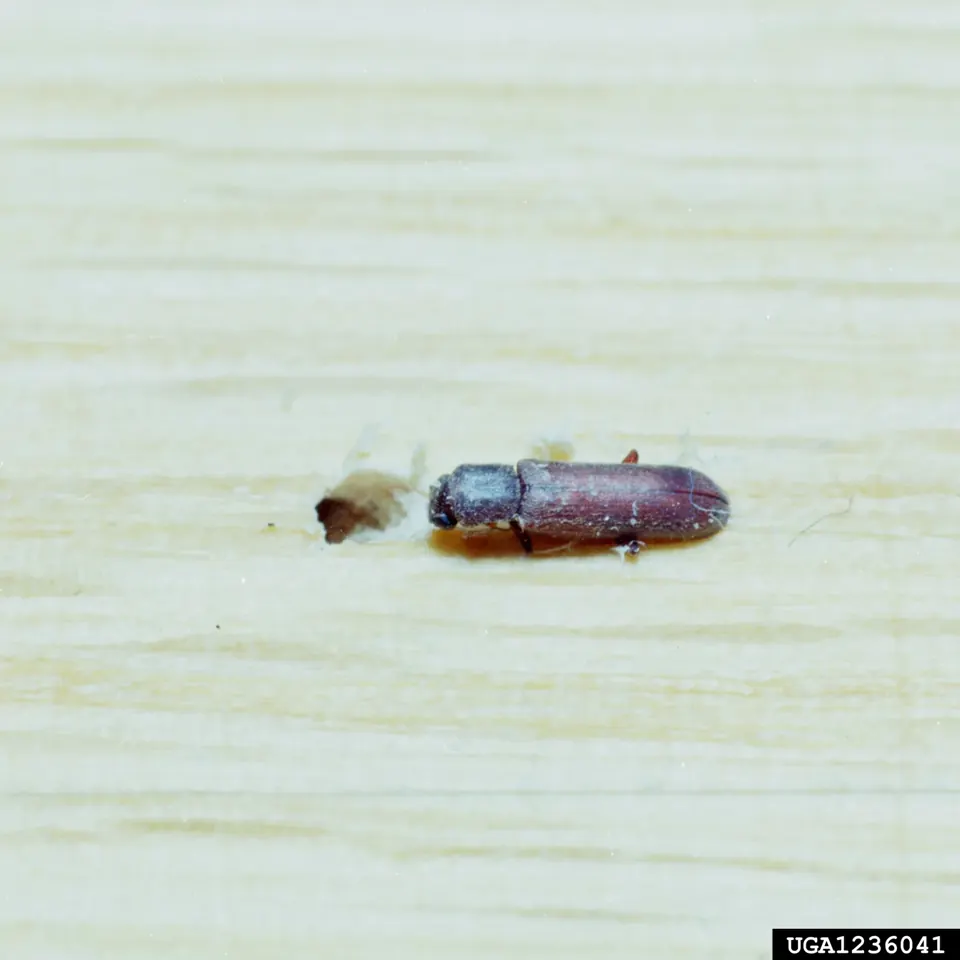
The adult lyctid powderpost beetle is a small, cylindrical brown beetle, about 3/32 to 1/4 inch long, that attacks hardwoods 17. UC IPM lists oak, ash, hickory, mahogany and walnut, in paneling, flooring, molding and furniture 5.
Deciding check on the wood: lyctid exit holes are round and only 1/32 to 1/16 inch across 1817. The powder that sifts from them feels like flour or talcum 5. Drywood termite pellets are larger, granular and ridged along their sides 5.
UC IPM uses a ballpoint pen as a gauge: only the tip fits a lyctid hole 5. Other wood-boring beetles leave larger holes: deathwatch beetles cut holes 1/16 to 1/8 inch across, while false powderpost beetle holes run from 3/32 to 9/32 inch 18.
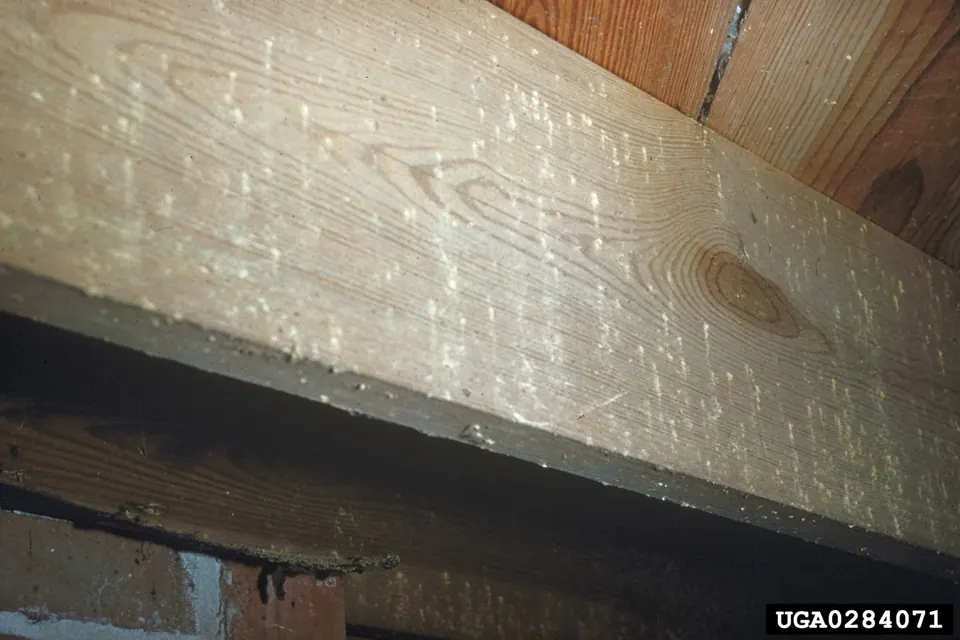
Sometimes the tiny round exit holes are the only sign of an infestation 5. Powder alone does not prove the beetles are still active, so Pacific Northwest Extension advises examining the wood closely for live insects 19.
Age of the wood is a clue. Lyctids rarely infest wood older than five years 20. Texas A&M adds that infestations in homes almost always start in wood that was infested before construction 17.
Where the infested wood cannot be replaced, borate insecticides can be applied to bare wood by a licensed pest control operator 5. Finished wood cannot be treated this way 5.
Booklice: tiny, pale and harmless
When the "termites" are tiny, pale and in a damp room, booklice are a likely answer. They are only 1 to 2 mm long, wingless and pale, and resemble miniature termites 3.
Deciding check: booklice have long, threadlike antennae, while termite antennae are beaded 3. A prominent head, well-developed eyes and a constriction behind the head also set them apart 3.
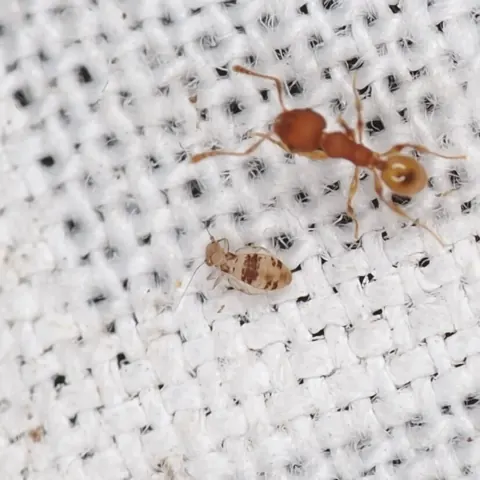
Booklice live almost always in damp areas that support the molds they feed on, such as bathrooms 3. University of Minnesota Extension describes them as rarely damaging and harmless to people and pets 21. They cannot bite 3.
Reducing moisture is the most effective way to manage them, because they cannot survive when humidity falls below about 45 to 50 percent 21. A dehumidifier or a fan lowers the humidity. Insecticides are normally not necessary 21.
Their outdoor relatives, the barklice, mostly have wings and live on bark and leaf litter 21. They are harmless to plants and need no treatment 21.
Web spinners in the desert Southwest
University of Arizona Extension lists web spinners as another insect confused with termites 10. Male web spinners have two pairs of nearly equal-sized wings, which defeats the wing check 10.
Deciding check: web spinners have a pair of cerci at the tip of the abdomen and an enlarged segment on each front foot 10.
Wood rot that passes for termite damage
Not every lookalike is an insect. Texas A&M AgriLife Extension notes that deterioration from wood-destroying fungi can be confused with termite damage 4.
Brown rot leaves wood brown or reddish, dry and crumbly 2223. It cracks across and along the grain until the wood breaks into small cubes 23. Brown rot is sometimes called "dry rot", although the fungus needs moisture to decay wood 22. White rot works differently, leaving a bleached, whitish, spongy or stringy area, mostly in hardwoods 22.
Deciding check: termite galleries contain mud or soil. Mississippi State University Extension states that damaged timber with galleries containing dried dirt is termite damage 24. Subterranean termite tunnels also follow the grain and are lined with mud or spotted fecal material 4.
Decay and termites can share a board, because both need moisture 423. Most decay fungi do poorly once the wood's moisture content falls below 30 percent 23. Damp, rotting wood also attracts dampwood termites and moisture ants 22. Correcting the moisture source is the fix in either case 22.
When one check is not enough
Some specimens are damaged, dried or photographed from the wrong side. A second look at the antennae and waist usually settles an ant, while a view of the back settles a beetle.
For a certain answer, specimens beat photos. Mississippi State's identification lab charges nothing and asks for several insects in ethyl or isopropyl alcohol in a leak-proof bottle 25. The UF/IFAS termite identification service in Fort Lauderdale is also free 26. Photos sent to a lab should be in focus, include a coin or ruler for scale, and carry the date and location 27.
If the check points back to termites after all, the termite identification key takes it from there to the termite group.
Questions
What bugs look like termites but are not?
The usual ones are winged ants, carpenter ants, acrobat ants, powderpost beetles and booklice. Ants have elbowed antennae and a pinched waist 1, while beetles have hard wing covers 2. Booklice have long, threadlike antennae instead of beaded ones 3.
What are the tiny white bugs that look like termites?
Pale insects only 1 to 2 mm long in a damp room are often booklice. They resemble miniature termites but have long, threadlike antennae, while termite antennae are beaded 3.
What bugs look like flying termites?
Winged ants are often mistaken for termite swarmers 10. Their elbowed antennae and front wings longer than the hind wings set them apart 1.
Sources
- University of Maryland Extension, Home and Garden Information Center. Ants and Termites: How to Tell the Difference. Updated October 17, 2024. extension.umd.edu
- NC State University, ENT 425 General Entomology. Order Coleoptera (course web page). Year not stated. genent.cals.ncsu.edu
- Colorado State University. Colorado Insects of Interest: Booklice (fact sheet). Year not stated. webdoc.agsci.colostate.edu
- Texas A&M University, Urban and Structural Entomology Program. Native Subterranean Termites, Reticulitermes sp. (web page). Year not stated. urbanentomology.tamu.edu
- Lewis, V. R., and S. J. Seybold. Pest Notes: Wood-Boring Beetles in Homes. UC ANR Publication 7418. UC Statewide IPM Program. Updated 06/2010. ipm.ucanr.edu
- Mississippi State University Extension Service, Dept. of Entomology. Are These Termites or Ants? Year not stated. extension.msstate.edu
- Su, N.-Y., R. H. Scheffrahn, J. Gordon, and T. Chouvenc. Formosan Subterranean Termite, Coptotermes formosanus. UF/IFAS EDIS EENY121 (IN278). Original January 2000; revised September 2025. ask.ifas.ufl.edu
- University of Hawaii at Manoa, CTAHR, Dept. of Plant and Environmental Protection Sciences. UH Termite Project, Alate Project: Identification Guide. Year not stated. manoa.hawaii.edu
- Morgan, A., D. Ring, L. Mao, et al. The Identification of Formosan Subterranean Termites. LSU AgCenter Pub. 2841 (dated 3/06). Additional authors not fully extracted. www.lsuagcenter.com
- Baker, P. B., and R. J. Marchosky, Jr. Arizona Termites of Economic Importance. University of Arizona Cooperative Extension AZ1369. June 2005. extension.arizona.edu
- Utah State University Extension. Pavement Ant (structural pest notes). Year not stated. extension.usu.edu
- Hu, X. P. Swarming Fire Ants. Alabama Cooperative Extension System. June 15, 2021 (modified June 11, 2025). www.aces.edu
- Brown, W., and R. E. Gold. Carpenter Ants. Texas AgriLife Extension Service, E-412 (dated 12-11). agrilifeextension.tamu.edu
- Klotz, S. A., L. D. Hansen, and M. K. Rust. Pest Notes: Carpenter Ants. UC ANR Publication 7416. UC Statewide IPM Program. Updated 08/2009. ipm.ucanr.edu
- Peterson, C., T. L. Wagner, J. E. Mulrooney, and T. G. Shelton. Subterranean Termites: Their Prevention and Control in Buildings. USDA Forest Service, Home and Garden Bulletin 64. Revised October 2006. research.fs.usda.gov
- Chouvenc, T., N.-Y. Su, and R. H. Scheffrahn. Native Subterranean Termites: Reticulitermes flavipes, R. virginicus, R. hageni. UF/IFAS EDIS EENY-212 (IN369). Original May 2004; revised July 2024. doi:10.32473/edis-in369-2001. ask.ifas.ufl.edu
- Merchant, M. Lyctid Powderpost Beetles: Suggestions for Control. Texas A&M AgriLife Extension, Insects in the City fact sheet ENT-2008. Year not stated. citybugs.tamu.edu
- Benson, E. P., and P. A. Zungoli. Wood-Boring Beetles in Houses. Clemson University Home and Garden Information Center, HGIC 2417. Originally published January 2001. hgic.clemson.edu
- DeAngelis, J. Preventing and Controlling Powderpost Beetles in and around the Home. Pacific Northwest Extension PNW 326 (reprinted July 1995). entomology.oregonstate.edu
- Koehler, P. G., F. M. Oi, and C. A. Andrews. Powderpost Beetles and Other Wood-Infesting Insects. UF/IFAS EDIS ENY-266 (IG119). Original March 1994; revised July 2022. doi:10.32473/edis-ig119-1994. ask.ifas.ufl.edu
- University of Minnesota Extension. Booklice and Barklice (Psocids). Year not stated. extension.umn.edu
- Washington State University, Pestsense. Wood-rotting fungi (fact sheet). Year not stated. pestsense.cahnrs.wsu.edu
- Weikert, S. Brown Rot in Wood. Penn State Extension. Updated August 20, 2026. extension.psu.edu
- Mississippi State University Extension Service, Dept. of Entomology. Signs of Termite Infestation. Year not stated. extension.msstate.edu
- Mississippi State University Extension Service. Insect Identification Service (termites). Year not stated. extension.msstate.edu
- UF/IFAS Fort Lauderdale Research and Education Center. Send Samples (Termites in Florida). Last modified June 15, 2026. flrec.ifas.ufl.edu
- LSU AgCenter, LSU Department of Entomology, and Louisiana State Arthropod Museum. Insect Identification Services. LSU AgCenter Publication 1838. Year not stated. www.lsuagcenter.com