Drywood termites
Western, West Indian and other drywood termites in the United States, with the evidence they leave and how infestations are treated.
Drywood termites live entirely inside dry, sound wood and need no contact with soil 1. The usual sign is a small pile of hard, six-sided pellets below a hole less than 2 mm wide 2. Treatment is either whole-structure, with fumigation or heat, or localized to the infested wood 2. Soil treatments and bait stations do not control drywood termites 3.
Outside buildings, drywood termites recycle dead wood. The western drywood termite is a native insect that has lived in California for millions of years, mostly in dead wood of trees along rivers, washes and arroyos 2.
In houses, drywood and subterranean termites are the two groups homeowners meet most often 3. Nearly all structural fumigation in Florida and Hawaii is done to control one drywood species, the West Indian drywood termite 4.
Maybe you swept up what looked like coarse sand on a windowsill. A week later, it was back.
But the colony sits inside the wood, often behind drywall, where its full extent is hidden. The choice usually comes down to tenting the whole house or spot treating the board you can see.
So how do you know which one your house needs?
We worked through the California, Florida, Texas and Arizona extension publications on drywood termites to answer that.
Warm coasts, and wherever infested wood travels
The natural range follows the warm edges of the country. Drywood termites occur from the Atlantic states south of Virginia through Florida and the Gulf Coast to the Mexican border 5. On the Pacific Coast they reach just north of San Francisco 5.
The western drywood termite (Incisitermes minor) is the most common structure-infesting drywood termite in the Southwest 1. It ranges through coastal and lower mountain areas of southern California, the Central Valley and east into central Arizona 1. In the Pacific Northwest it is uncommon 6.
Florida's most common structure-infesting drywood termite is the West Indian drywood termite (Cryptotermes brevis) 1, with its largest populations in older buildings in the southern half of the state 4. It also occurs in Hawaii and along the Gulf Coast 4. Outside its native coastal desert of Peru and Chile, it has been found only in structures 4.
Texas has three common drywood species, with the highest concentrations along the Gulf Coast 7. Arizona adds the light western drywood termite (Marginitermes hubbardi), a significant pest at lower elevations such as Phoenix and Tucson 8.
Several native species rarely enter buildings. In Florida, the light southeastern drywood termite and the dark southern drywood termite live mostly in dead tree branches 9.
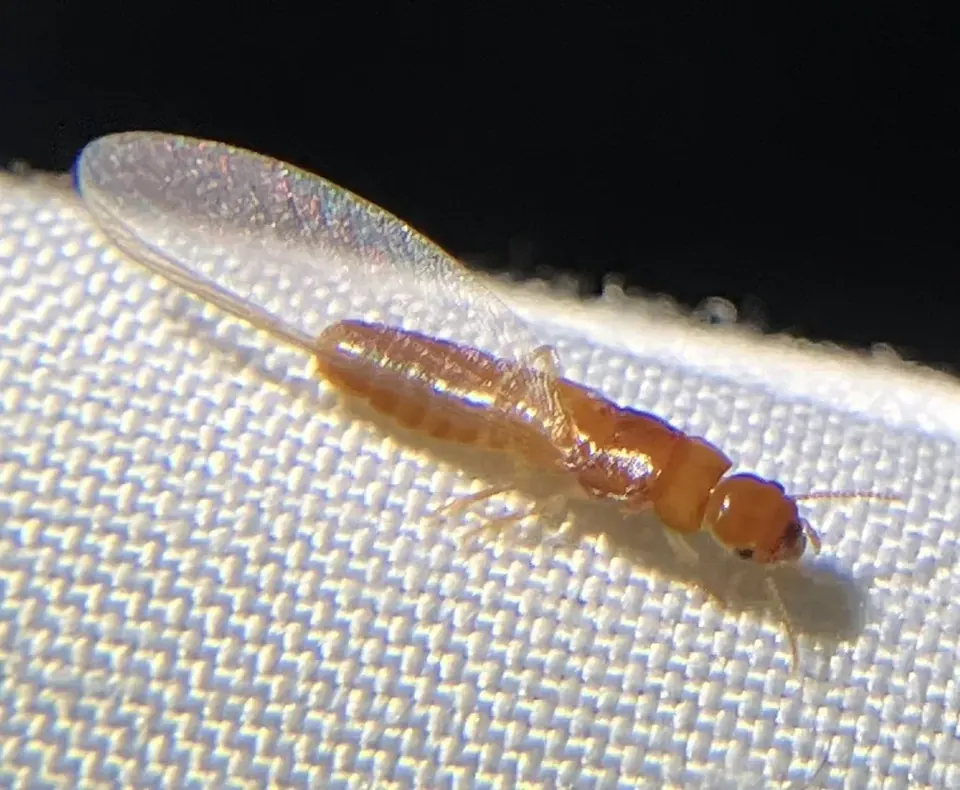
Because drywood termites travel in wood, infestations turn up far from these ranges. The western drywood termite has been found in states from New York to Texas, carried in furniture and other wood products 18.
Pellets, kick-out holes and swarmers: the evidence
Pellets
Workers push their dry fecal pellets out of the wood through tiny kick-out holes 1. The pellets pile up on surfaces below, or spread in a scatter circle when the hole is high off the floor 4.
Each pellet has six flattened sides along its length, a shape that is diagnostic for drywood termites 2. Western drywood pellets average 0.98 mm long, against 0.87 mm for the West Indian drywood termite 1. They feel dry and gritty when rolled between the fingers 1.
Color is not a reliable clue. West Indian drywood termite pellets can be cream, red or black whatever the color of the wood 4. Homeowners often mistake the pellet piles for sawdust 1.
Pellets alone cannot show whether the colony is still alive or how far it extends 2. Clearing the pellets around a hole and checking a few days later helps, though building vibrations can shake old pellets loose too 2.
Kick-out holes
The holes are about 1 to 2 mm across 4, roughly the size of a pen tip 3. When not in use, the termites usually seal them with a plug of feces and pellets 1.
Under the surface, the galleries are smooth and cut across the grain of the wood 3. Western drywood termites often excavate toward the outer surface without breaking through, leaving a paper-thin shell over the damage 1. Blistering or peeling paint and thin surface wood can be the only outward sign 4.
Swarmers
Winged reproductives are usually the first sign of a drywood infestation 7. They are also needed for a proper identification, so the shed wings are worth keeping 7.
Drywood wings have three or more heavy veins along the front margin, while Formosan termite wings have two 10. West Indian drywood termite wings are hairless and vividly iridescent 4.
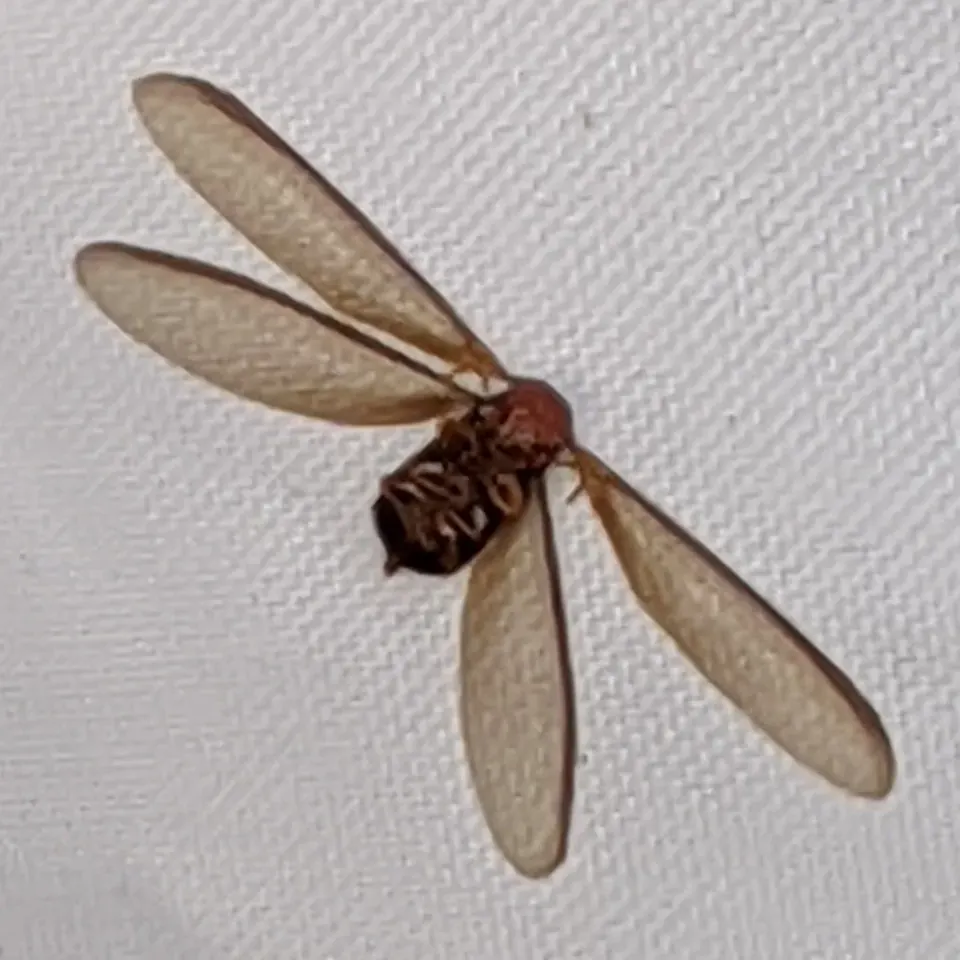
The western drywood termite swarmer has an orange-brown head and pronotum, a dark brown abdomen and smoky wings 1. It measures 11 to 12.5 mm long including the wings 1. In southern California it flies by day from late September through November, usually on bright days between about 80 and 100°F 1.
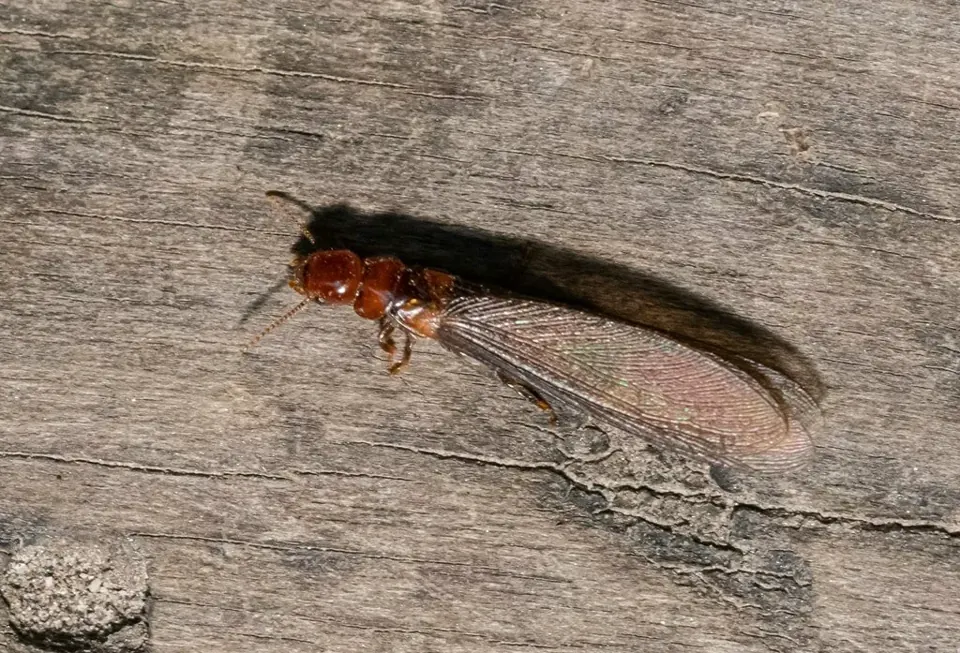
West Indian drywood termites fly mainly from April to June, though flights can occur in any month 4. Swarmers found indoors almost always mean the termites are in the structural timbers 7.
Soldiers
Drywood soldiers have a pronotum as wide as or wider than the head, which separates them from subterranean soldiers 11. The West Indian drywood termite soldier has a dark, rough head 4, blunt enough that it is sometimes compared to a burnt matchstick 3.
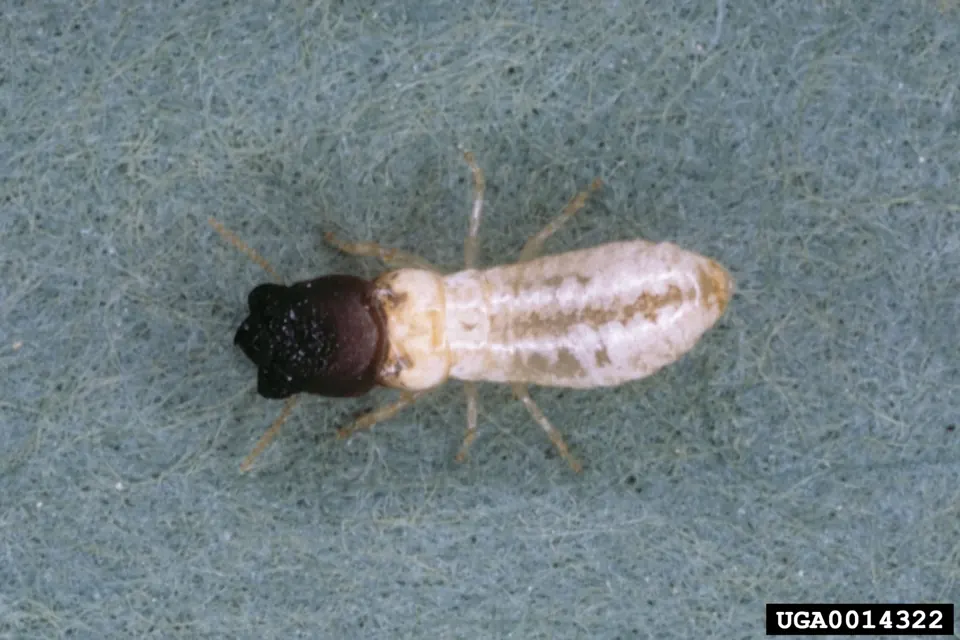
Western drywood termite soldiers instead carry a large reddish-brown head with an enlarged, club-like third antennal segment 1.
Furniture, attics and the places colonies hide
Drywood colonies are small, usually fewer than 1,000 individuals 2. Several of them can be scattered through one building 2. A colony is often contained in a single piece of wood 3.
They also grow slowly: a western drywood colony may take five to seven years to produce visible feeding damage 1.
Inside a home, drywood termites more commonly infest soffits and attics 3. In Texas they favor wood under roof shingles, eaves and siding 7. In Arizona, the light western drywood termite attacks flooring, windows, door frames, soffits, fascia boards and even roof sheathing 8.
Furniture is a frequent host 3. In Florida, the western drywood termite has been found only indoors, often in imported furniture 9.
Finding every colony is difficult. Inspectors look for damage, shed wings, pellets and kick-out holes, but hidden infestations may require removing walls, paneling or stucco 2.
Whole-structure or localized treatment?
Every drywood treatment falls into one of two categories 2. A whole-structure treatment hits all infestations at once, accessible or not 2. A localized or spot treatment targets a single board or a small group of boards 2.
Whole-structure treatments should eliminate hidden colonies as well as visible ones 2. With localized treatment, one can never be sure every infestation has been reached 2.
Fumigation
The house is covered with gas-tight tarps and filled with sulfuryl fluoride, then aerated 4. Fumigation kills drywood termites within several days 2. A monitored fumigation, with gas monitoring lines inside the house, has the highest rate of success 2.
UF/IFAS calls fumigation highly effective, a reset button for drywood termites 3. Occupants, pets and plants must leave for several days 2. Tarps dragged across the roof can damage it 2. California and Florida perform the most fumigations in the country 3.
Heat
Heat treatment raises all the wood in the structure to at least 120°F and holds it there for at least 33 minutes 2. The house is vacated for hours instead of days, with no chemical residue left behind 2.
Large beams can take hours or days to heat through to the core 2. Wood against concrete or tile acts as a heat sink and can stay too cool 2. Heat can also damage plastics, wiring and other heat-sensitive items 2. In Florida, heat is usually used on single rooms or apartments rather than whole houses 4.
Localized treatment
Drill-and-treat applications inject insecticide into the galleries or kick-out holes 4. Research shows high control when the colony is correctly located and the product reaches the termites 2.
Microwaves and high-voltage electrocution are other localized options, with highly variable results 2. Lab and field tests question the efficacy of orange oil (d-limonene) 2.
Wood replacement works when the infestation is confined to trim such as a door or window casing 3. An infested piece of furniture can simply be removed 3.
How to choose
The decision rests on how much of the infestation can be found.
- Widespread or hidden infestations. Fumigation is the primary method when infestations are inaccessible or spread through the structure 4.
- One accessible board, trim piece or item of furniture. Wood replacement, removal or a spot treatment can work, provided a thorough inspection has found the termites 3.
- Uncertain extent. UC IPM advises getting at least three structural inspection reports before choosing a company and method 2.
Except for wood removal, drywood control belongs with professionals, because the products needed are not available for homeowner use 2.
After any treatment, cleaning up all pellets and wings sets up a simple check. New, growing piles of pellets or fresh swarmers usually mean the treatment failed 4.
Why soil treatment and bait stations do not apply
Drywood colonies are not connected to the ground, so their galleries contain no soil 3. A soil termiticide or a bait system placed in the yard never meets them.
UF/IFAS lists soil termiticides, baits and physical barriers as subterranean termite tools with no role against drywood termites 3. The reverse holds as well: fumigation and heat cannot reach subterranean termites nesting below ground 12.
Prevention focuses on the wood and the openings instead. Screening vents and openings with mesh finer than about 1 mm blocks swarmers, though complete exclusion is almost impossible 4. Keeping soffits in repair and vents screened also helps keep swarmers out of attics 3.
Questions
Do drywood termites need soil or water?
No. Drywood termites live entirely within dry wood and need no contact with the ground 1. They get water from the wood they eat or produce it through their own metabolism 1.
Can drywood termites spread through furniture?
Yes. Drywood termites are commonly found in furniture 3. Moving infested wood has carried the western drywood termite to isolated sites across the United States 1.
Is spot treatment as good as tenting?
Only when the whole infestation has been found. A whole-structure treatment should eliminate hidden colonies, while a localized treatment always leaves some doubt about colonies inside walls 2.
How long do you leave the house for termite fumigation?
Occupants, pets and plants must leave for several days while the house is fumigated and aerated 2. Heat treatment usually needs the house empty for hours instead of days 2.
Are drywood termite pellets the same color as the wood?
Not necessarily. West Indian drywood termite pellets can be cream, red or black. Their color does not depend on the color of the wood 4.
Sources
- Cabrera, B. J., and R. H. Scheffrahn. Western Drywood Termite, Incisitermes minor. UF/IFAS EDIS EENY248 (IN526). Original November 2001; revised December 2005; reviewed February 2021. ask.ifas.ufl.edu
- Lewis, V. R., A. M. Sutherland, and M. I. Haverty. Pest Notes: Drywood Termites. UC ANR Publication 7440. UC Statewide IPM Program. Updated 08/2014. ipm.ucanr.edu
- Oi, F. M., J. Davis, J. McConnell, J. Corbus, N. Nelson, and M. Atkinson. Termite Prevention and Control. UF/IFAS Extension ENY-2044 (IN1277). Original March 2020; revised December 2023. ask.ifas.ufl.edu
- Gordon, J. M., R. H. Scheffrahn, and N.-Y. Su. West Indian Drywood Termite, Cryptotermes brevis. UF/IFAS EDIS EENY-79 (IN236). Original April 1999; revised December 2025. doi:10.32473/EDIS-in236-2020. ask.ifas.ufl.edu
- Peterson, C., T. L. Wagner, J. E. Mulrooney, and T. G. Shelton. Subterranean Termites: Their Prevention and Control in Buildings. USDA Forest Service, Home and Garden Bulletin 64. Revised October 2006. research.fs.usda.gov
- Oregon State University Extension. Solve Pest Problems: Termites. Year not stated. solvepestproblems.oregonstate.edu
- Texas A&M University, Urban and Structural Entomology Program. Drywood Termites (web page). Year not stated. urbanentomology.tamu.edu
- Baker, P. B., and R. J. Marchosky, Jr. Arizona Termites of Economic Importance. University of Arizona Cooperative Extension AZ1369. June 2005. extension.arizona.edu
- Chouvenc, T., R. H. Scheffrahn, and L. Buss. Termite Species Distribution in Florida and UF Termite Identification Services. UF/IFAS EDIS ENY-2079 (IN1360). Original May 2022; reviewed February 2025. doi:10.32473/edis-IN1360-2022. ask.ifas.ufl.edu
- Gold, R. E., M. Keck, E. Brown, and K. Schofield. Formosan Subterranean Termites. Texas AgriLife Extension Service, E-367 (dated 9/10). extensionentomology.tamu.edu
- Chouvenc, T., N.-Y. Su, and R. H. Scheffrahn. Native Subterranean Termites: Reticulitermes flavipes, R. virginicus, R. hageni. UF/IFAS EDIS EENY-212 (IN369). Original May 2004; revised July 2024. doi:10.32473/edis-in369-2001. ask.ifas.ufl.edu
- Lewis, V. R., M. I. Haverty, and A. M. Sutherland. Pest Notes: Subterranean and Other Termites. UC ANR Publication 7415. UC Statewide IPM Program. Updated 05/2014. ipm.ucanr.edu