Flying ants vs termites
The four characters that university extension entomologists use, each shown on real specimens.
The antennae give the quickest answer: flying ants have elbowed antennae, while termites have straight, bead-like ones 1. Ants also have a pinched waist and front wings longer than their hind wings, whereas termite wings are all the same length 2. When the wings are already gone, short wing stubs mark a termite, since ants keep none 3.
Swarming is the one time termites become plainly visible 4, which makes it the best moment to tell them from ants. Both send out winged reproductives to start new colonies, often at about the same time of year 5.
You may have found a dozen winged insects on a windowsill this morning, or watched a cloud of them circle the porch light last night.
If they are termites, Mississippi State University Extension says the building is infested and needs professional treatment, at around a thousand dollars or more 6. If they are ants, you may be able to treat them yourself; even a hired pest control company costs far less 6.
So which one is on your windowsill? We compared the four characters that extension entomologists rely on, using licensed photos of both insects.
Antennae: an elbow or a string of beads?
An ant's antennae bend sharply, at about a right angle partway along 7. The segments beyond the bend look relatively smooth 2. LSU AgCenter adds that ant antennae are usually clubbed at the tip 8.
Termite antennae point straight out and are built from small, round, bead-like segments 34. The difference is visible to the naked eye 9, although a hand lens makes it easier still 6.
The angle of the photo matters. A view from the side or slightly in front shows the elbow of an ant clearly, while a view straight down can hide it.
The waist settles it when the antennae are hidden
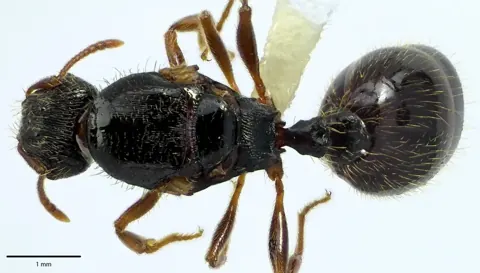
Ants have a narrow constriction, the petiole, where the abdomen joins the thorax 3. Extension guides call it a pinched or wasp waist 1. UF/IFAS notes that most people can see the waist on an ant 10.
A termite has no waist at all. Its body is uniform and tube-like from the head back 2.
Looked at closely, the ant waist carries one or two small bumps called nodes. Carpenter ants have one node 7, while fire ant swarmers 11 and pavement ants 12 have two.
Four wings, but only termite wings match
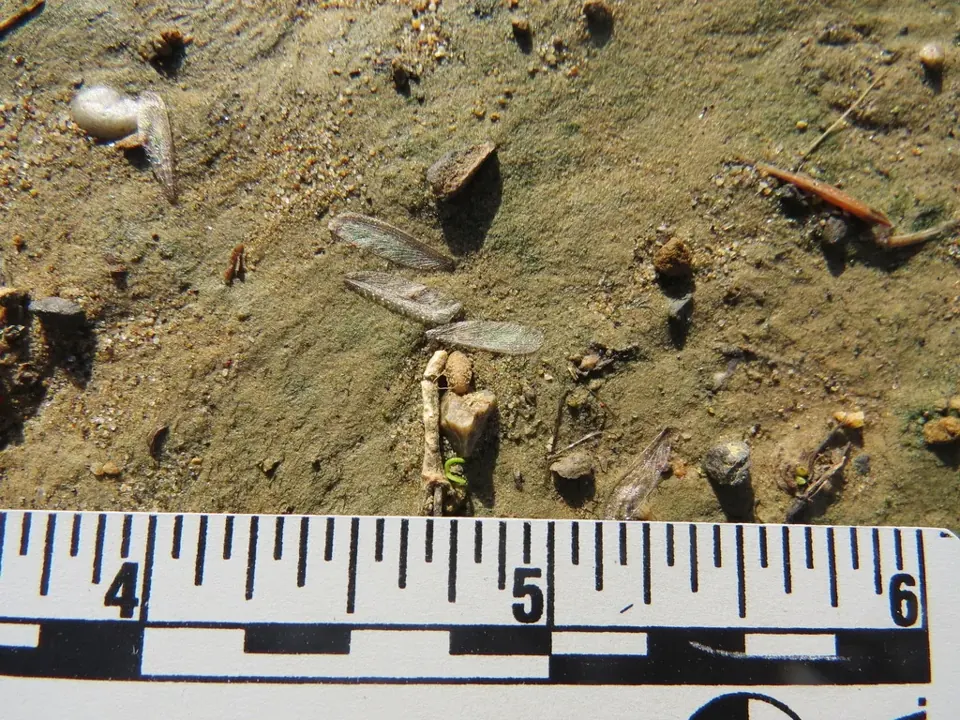
Both insects have four wings. In flying ants the front wings are longer than the hind wings and often tinted brown 1. Termite wings are similar in shape and length, pale and translucent 1.
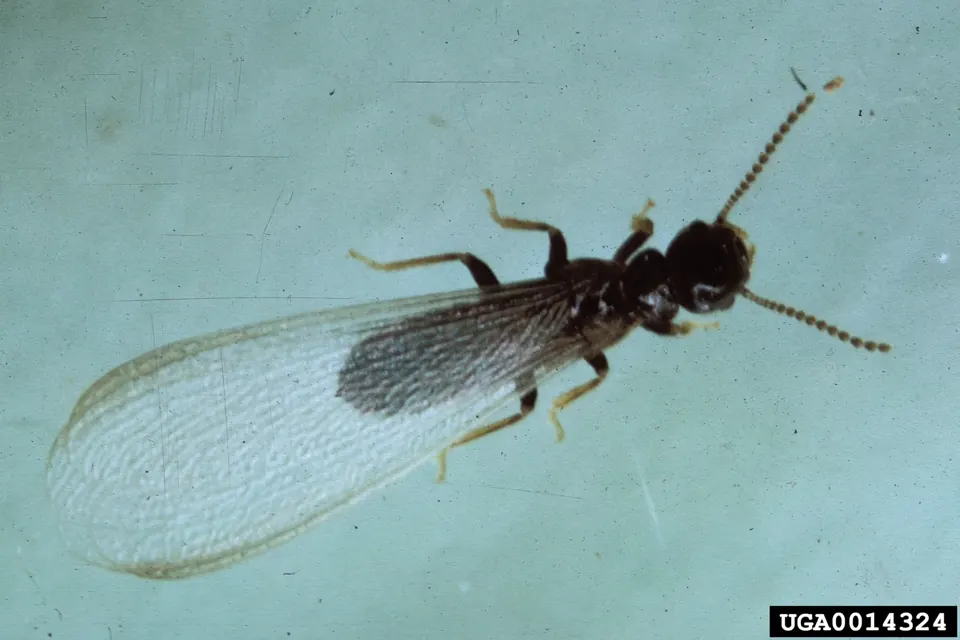
Termite wings are also long for the body. Purdue Extension describes native subterranean swarmers as having four equal wings that extend past the body 4. Mississippi State gives the termite wing as about twice as long as the body 6.
The vein pattern differs as well. Texas A&M's comparison shows ant wings unlike each other in shape, size and pattern, with few veins 7. The ant forewing also has a stigma, a small spot on its front edge, which termite wings lack 8.
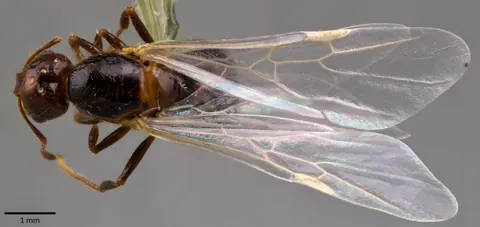
At rest, termite wings generally fold over the back 13, with the hind pair hidden under the front pair, so equal length is hard to judge. A shed wing, or a gently spread one, shows the full shape.
Equal wings alone do not prove a termite, either. In Arizona, male web spinners also have two pairs of nearly equal wings 9. They differ from termites in having a pair of cerci at the tip of the abdomen and enlarged segments on the front feet 9.
Wings gone? The stubs still tell you
Termites and ants both shed their wings shortly after swarming 6. In termites, the wings break off at their base and are discarded, sometimes in piles 4. Mated fire ant queens snap their wings off at a line near the base called the basal suture 14.
What stays behind differs. A termite that has dropped its wings keeps short wing stubs, while an ant keeps none 3.
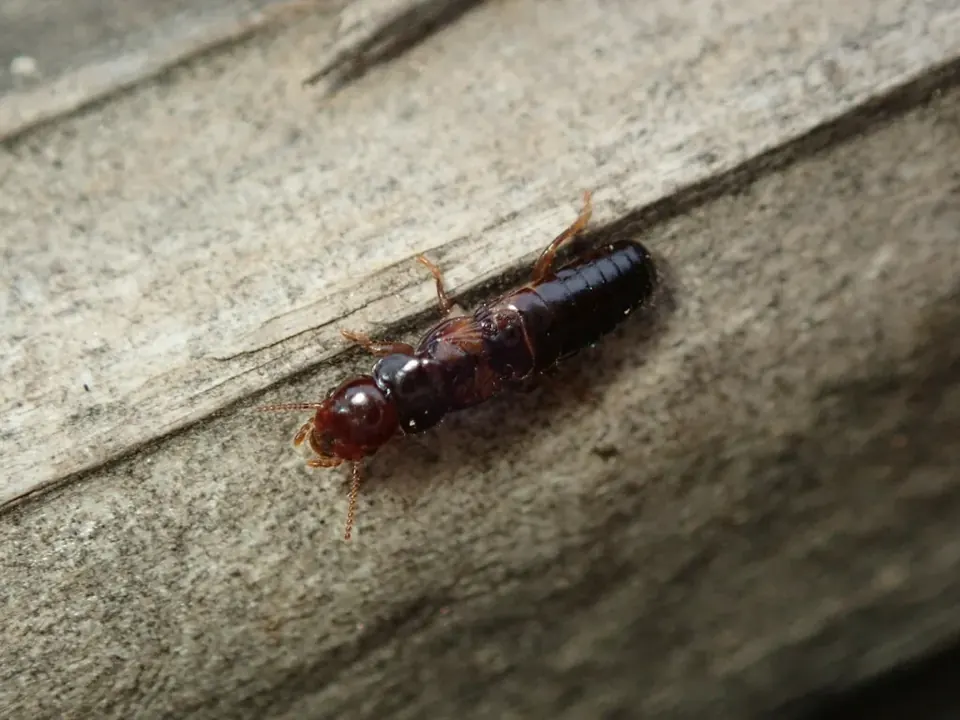
Termite behavior after the flight is distinctive too. Mated pairs drop to the ground, lose their wings and run off in what NC State Extension calls a "train", the female leading and the male close behind 2.
A wingless ant queen is still easy to place. Her antennae remain elbowed and her waist remains pinched 1. Ant workers never have wings in the first place 6.
Loose wings on a sill keep the equal-length pattern, which is why NC State Extension suggests collecting the insects, or just their wings, for identification 2.
Color, size and hardness: clues that mislead
Color seems like the obvious check, but the ranges overlap. Eastern subterranean termite swarmers are black, while Formosan swarmers are tan to light brown 6. Ant swarmers vary from light tan to black, depending on the species 6.
Size overlaps just as much. Native subterranean termite swarmers are about 1/4 to 3/8 inch long 4, with Formosan swarmers about 1/2 inch including the wings 15. Between them sit fire ant swarmers at about 1/3 inch 11, while winged carpenter ants reach 3/4 inch 7.
Body texture is a little more useful. Ants are hard-bodied and generally dark, while termites are soft-bodied and lighter 8. That contrast is strongest in wingless workers, though, so for swarmers it only supports what the antennae, waist and wings already show.
Who swarms when, and why the calendar cannot decide
Native subterranean termites usually swarm in daytime, frequently in spring and often after rain 2. Formosan termites fly at dusk on warm, humid, windless evenings and gather at lights 16. Subterranean termites can fly at any time of year, even in winter inside buildings with heated basements 17.
Ants keep similar hours. Carpenter ants swarm in spring and early summer 7. In Texas it is not uncommon for them to swarm at the same time as termites 7. The western black carpenter ant tends to fly in the late afternoon, often after heavy rain 18.
Fire ants make six to eight mating flights between spring and fall, usually at midday on a warm, sunny day after rain 14. Their swarmers are drawn to reflective water such as swimming pools 11. Pavement ants typically swarm in spring after rain and can swarm indoors 12.
With this much overlap, the date and weather of a swarm can back up an identification but cannot make one.
What each answer means for your house
Termite swarmers inside
Purdue Extension calls winged termites in a building a near-certain sign that the structure is infested 4. Killing or vacuuming the swarmers does nothing about the colony that produced them 152.
Termite swarmers trapped indoors usually die, because they cannot reach the moist soil they need 19. The colony feeding on the building is the problem, so a professional termite inspection is the next step. Collecting a few swarmers in alcohol before vacuuming the rest keeps specimens for identification 20, one of the first steps after an indoor swarm of flying termites.
Termite swarmers outside
Swarmers emerging outdoors but very near the foundation may or may not mean the building is infested 15. Mississippi State treats it as cause for further investigation and a professional inspection 15.
Swarmers coming from a stump or woodpile 25 feet or more from the foundation are rarely a concern 15. NC State Extension lists old stumps, landscape timbers and any wood touching soil as likely colony sites in a yard 2. Those colonies matter later, because the swarmers they produce in future years may attack a house that is unprotected 2. An outdoor swarm is a good reminder to check when the building was last treated 15.
Formosan termites follow their own rule. In a heavily infested neighborhood, a few dozen Formosan swarmers inside a properly treated building may have flown in from outside. Hundreds indicate a current problem, whatever the treatment history 15.
Ant swarmers
Flying ants are usually a smaller problem. Mississippi State notes that ants may still need treatment, but often one you can do yourself 6.
An ant swarm inside the house is not unusual. Pavement ants, light to dark brown with fine grooves lining the head and thorax, nest under foundations, enter through cracks in concrete and can swarm indoors 12.
Carpenter ants deserve a second look, because they nest in wood that is moist or has been damaged by water or termites 7. Their coarse, shredded-wood debris and clean, smooth galleries look different from termite damage, as the side-by-side of carpenter ants and termites shows 7. Fire ant swarmers in a yard signal new mounds to come 11.
Still unsure
Specimens settle what photos cannot. NC State Extension suggests bringing specimens to a county Extension center for identification 2. Mississippi State's lab identifies insects for free when they arrive preserved in ethyl or isopropyl alcohol 20. Many other states offer termite identification through Extension, usually for a nominal fee 10.
Questions
Do flying ants mean termites?
Not by themselves. Flying ants are ant reproductives, recognized by elbowed antennae and a pinched waist 1. Carpenter ant swarmers indoors can still point to moist or damaged wood worth checking 7.
Do flying ants damage wood?
Carpenter ants are the ones that do. They excavate wood to build nests but do not eat it 7. Pavement ants nest under stones, pavement and foundations instead 12.
What if the flying insects have lost their wings?
Short wing stubs on the thorax settle it: termites keep stubs after shedding their wings, while ants do not 3.
Sources
- University of Maryland Extension, Home and Garden Information Center. Ants and Termites: How to Tell the Difference. Updated October 17, 2024. extension.umd.edu
- Crawley, S., and C. C. Hayes. Termite Swarmers: What Do They Mean for You? NC State Extension Publications. Published Dec. 1, 2009; reviewed/revised Feb. 24, 2023. content.ces.ncsu.edu
- University of Hawaii at Manoa, CTAHR, Dept. of Plant and Environmental Protection Sciences. UH Termite Project, Alate Project: Identification Guide. Year not stated. manoa.hawaii.edu
- Gibb, T. J. Finding Winged Termites Is a Red Flag. Purdue Extension Hot News HN-61-W. Dated 5/15/2009. extension.entm.purdue.edu
- Texas A&M University, Urban and Structural Entomology Program. Native Subterranean Termites, Reticulitermes sp. (web page). Year not stated. urbanentomology.tamu.edu
- Mississippi State University Extension Service, Dept. of Entomology. Are These Termites or Ants? Year not stated. extension.msstate.edu
- Brown, W., and R. E. Gold. Carpenter Ants. Texas AgriLife Extension Service, E-412 (dated 12-11). agrilifeextension.tamu.edu
- Morgan, A., D. Ring, L. Mao, et al. The Identification of Formosan Subterranean Termites. LSU AgCenter Pub. 2841 (dated 3/06). Additional authors not fully extracted. www.lsuagcenter.com
- Baker, P. B., and R. J. Marchosky, Jr. Arizona Termites of Economic Importance. University of Arizona Cooperative Extension AZ1369. June 2005. extension.arizona.edu
- Oi, F. M., J. Davis, J. McConnell, J. Corbus, N. Nelson, and M. Atkinson. Termite Prevention and Control. UF/IFAS Extension ENY-2044 (IN1277). Original March 2020; revised December 2023. ask.ifas.ufl.edu
- Hu, X. P. Swarming Fire Ants. Alabama Cooperative Extension System. June 15, 2021 (modified June 11, 2025). www.aces.edu
- Utah State University Extension. Pavement Ant (structural pest notes). Year not stated. extension.usu.edu
- Baker, P. Termite Management for Homeowners. University of Arizona Cooperative Extension AZ1356 (dated 3/2005). extension.arizona.edu
- Collins, L., and R. H. Scheffrahn. Red Imported Fire Ant, Solenopsis invicta. UF/IFAS EDIS EENY-195 (IN352). Original January 2001; revised November 2013; reviewed May 2020. ask.ifas.ufl.edu
- Mississippi State University Extension Service, Dept. of Entomology. Signs of Termite Infestation. Year not stated. extension.msstate.edu
- Sun, Q. Preparing for the Termite Swarms. LSU AgCenter. Published April 20, 2026. www.lsuagcenter.com
- Peterson, C., T. L. Wagner, J. E. Mulrooney, and T. G. Shelton. Subterranean Termites: Their Prevention and Control in Buildings. USDA Forest Service, Home and Garden Bulletin 64. Revised October 2006. research.fs.usda.gov
- Klotz, S. A., L. D. Hansen, and M. K. Rust. Pest Notes: Carpenter Ants. UC ANR Publication 7416. UC Statewide IPM Program. Updated 08/2009. ipm.ucanr.edu
- Layton, B. Eastern Subterranean Termite Swarmers. Bug's Eye View, Vol. 8, No. 2 (2022). Mississippi State University Extension Service. extension.msstate.edu
- Mississippi State University Extension Service. Insect Identification Service (termites). Year not stated. extension.msstate.edu