Termite inspection
What the inspection covers and what the report can tell you, from extension guidance in Texas, Florida, California, North Carolina, Mississippi and Arizona.
A termite inspection is a visual search of the accessible parts of a house for mud tubes, damaged wood, swarmers, shed wings and pellets 12. It also records conditions that invite termites 1. The inspector probes and taps wood, checks the foundation, crawl space, attic and plumbing entries, and notes what could not be reached 31. Extension services recommend one before any treatment 4.
Termites typically work slowly, so a proper inspection can find an infestation and get it controlled before it weakens structural timbers 5.
Inspections are also how many infestations come to light. UC IPM lists a real estate inspection, a remodel, a tube appearing on a wall and a sudden indoor swarm as the usual moments of discovery 4.
Perhaps you found a tube on the foundation last weekend, or a lender wants a report before closing on a house.
But the inspector reports only on the parts of the house that can be seen and reached 1. So what does an inspector check, and how much does a clean report tell you? We combined the inspection checklists published by Texas A&M, UF/IFAS and UC IPM to answer both.
What happens during the inspection
In California, a termite inspection must include at least a visual search of accessible areas 2. A Texas wood-destroying insect inspection is also visual, so the inspector does not have to move furniture or look behind walls 1.
Inspectors probe and tap baseboards, door frames and other common entry points, because subterranean termites can leave only a thin veneer of sound wood at the surface 3. Severely damaged wood sounds hollow when tapped. Prodding it with a screwdriver shows whether it is still sound 5.
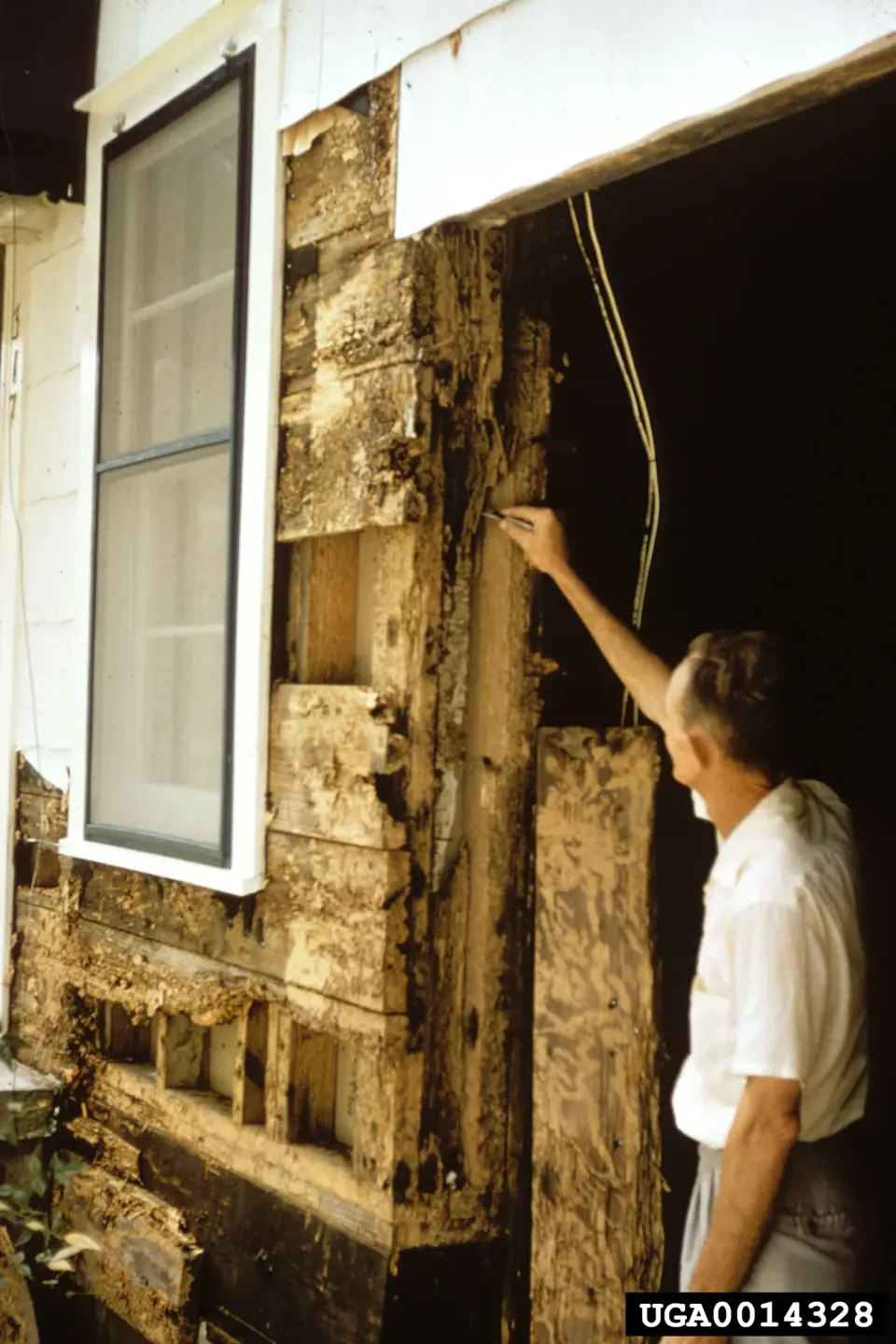
The usual kit, as Texas A&M lists it, is a flashlight, an ice pick or sharp-pointed screwdriver, a ladder and protective clothing, plus a floor plan on graph paper that records the findings and confirms that the whole structure was examined 1.
A moisture meter finds damp areas in walls that may hide shelter tubes or carton nests. Some inspectors add fiber-optic borescopes, acoustic detectors, infrared cameras or trained dogs, which help without guaranteeing that every termite or every patch of damage is found 1. Visual inspection remains the mainstay of the industry 2.
Outside: everything that touches the soil
Subterranean termites usually enter through wood close to or touching the soil, particularly at porches, steps, terraces, fences and planters 5. The outside checklist from Texas A&M follows those routes 1:
- The foundation of the house, garage and other structures, for shelter tubes rising from the soil.
- Attached porches, connecting patios and sidewalks, and confined or hard-to-see places.
- Soil moisture around the foundation, where faulty grading keeps the ground wet.
- Window and door frames, and the points where air conditioning lines, gas and electric services enter.
- Roof eaves and gutters, for defects that cause leaks and wood rot.
- Areas behind dense shrubs, and anywhere earth contacts wood: fences, stair carriages, deck supports and trellises.
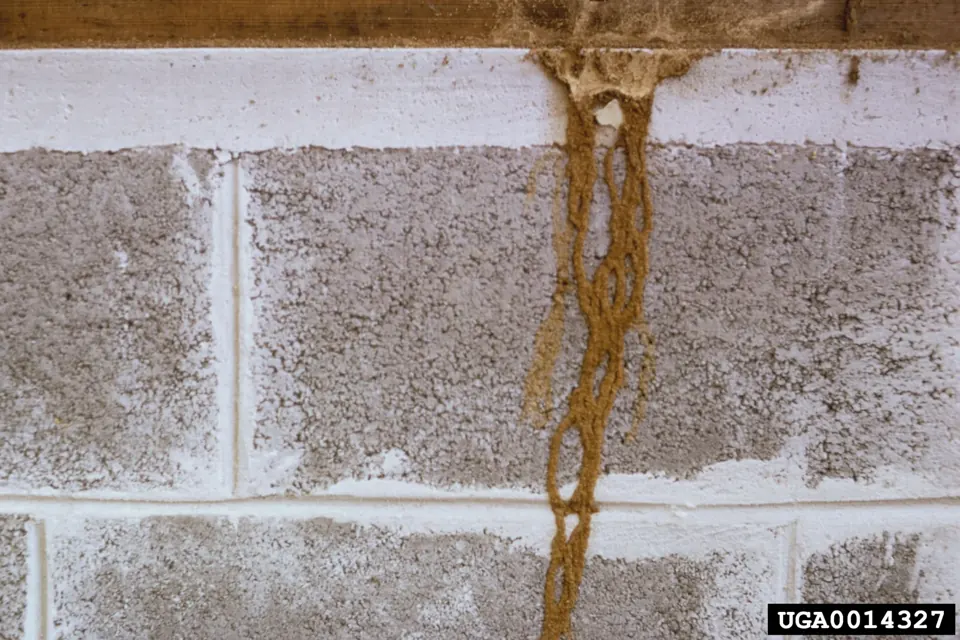
Building codes in many states require at least a 6-inch inspection space between siding and soil at construction, because that bare strip is where tubes become visible. Mulch or plants piled against the wall hide it 3.
Stucco siding that reaches the ground can let termites travel unseen between the stucco and the foundation 4.
Inside: walls, floors, plumbing, crawl space and attic
Inside, the inspector looks for shelter tubes on walls and for discoloration or staining that points to water leaks 1. Door and window facings, baseboards and hardwood floors are probed carefully so finished wood is not marked 1.
The rest of the Texas A&M interior list covers 1:
- Earth-filled porches, joints in the slab or floor, cracks and expansion joints in the foundation, and blistered paint or wallboard.
- Places where plumbing or utility pipes pass through the foundation or floor, especially the bath trap area on slab houses.
- The attic, for tubes, leaks, wood rot and damaged wood.
- The crawl space, which should leave at least 18 inches between floor joists and soil. Standing water there needs remediation.
BB-sized spots of dried mud on drywall or paneling are termite "pinholes", where workers sealed an accidental opening; they are a sure sign of an active infestation 6. Tubes high on interior walls or ceilings usually mean Formosan termites 6.
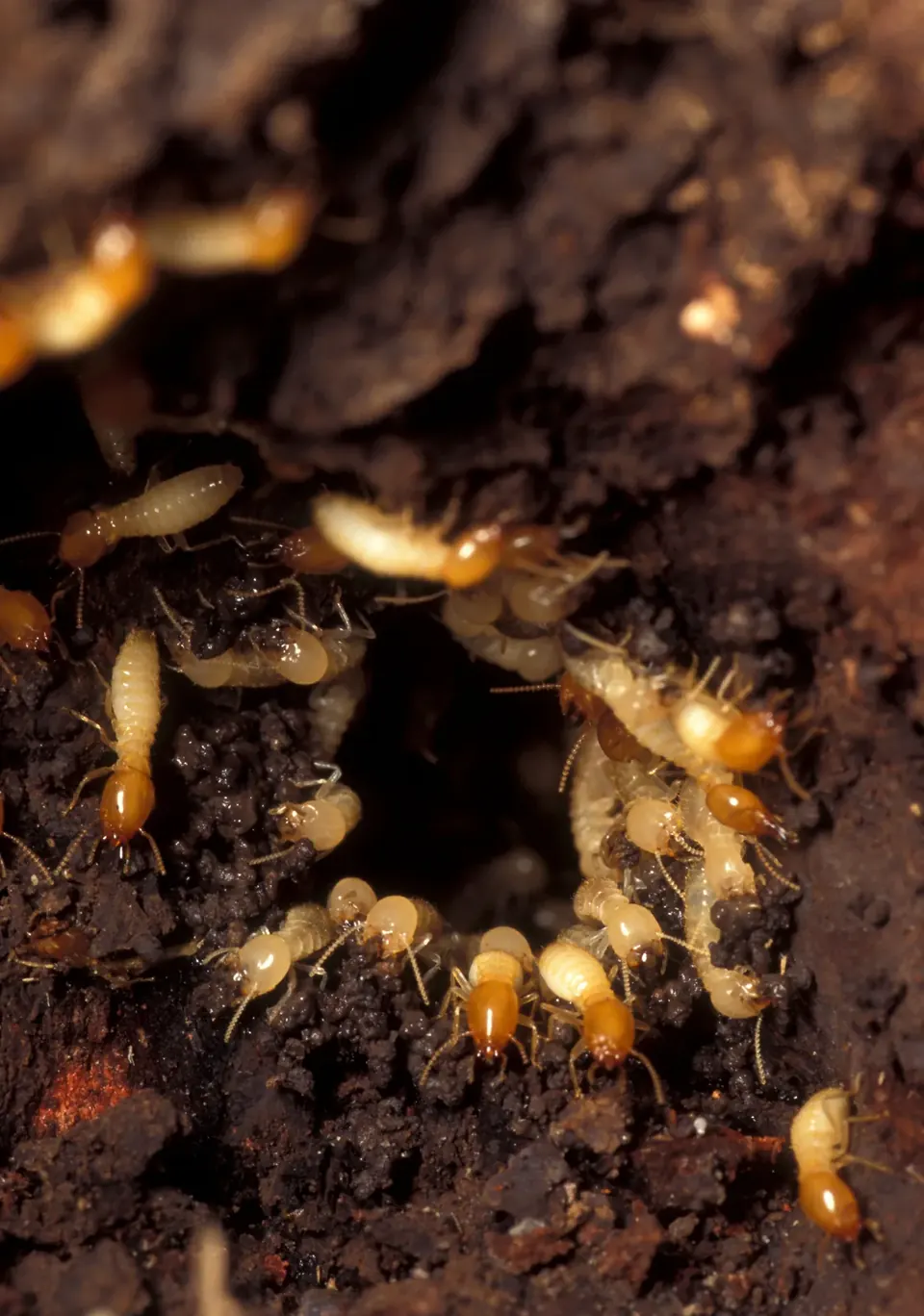
Spray foam over crawl-space joists or around duct work can make an area impossible to inspect thoroughly 3.
Drywood inspections follow pellets and holes
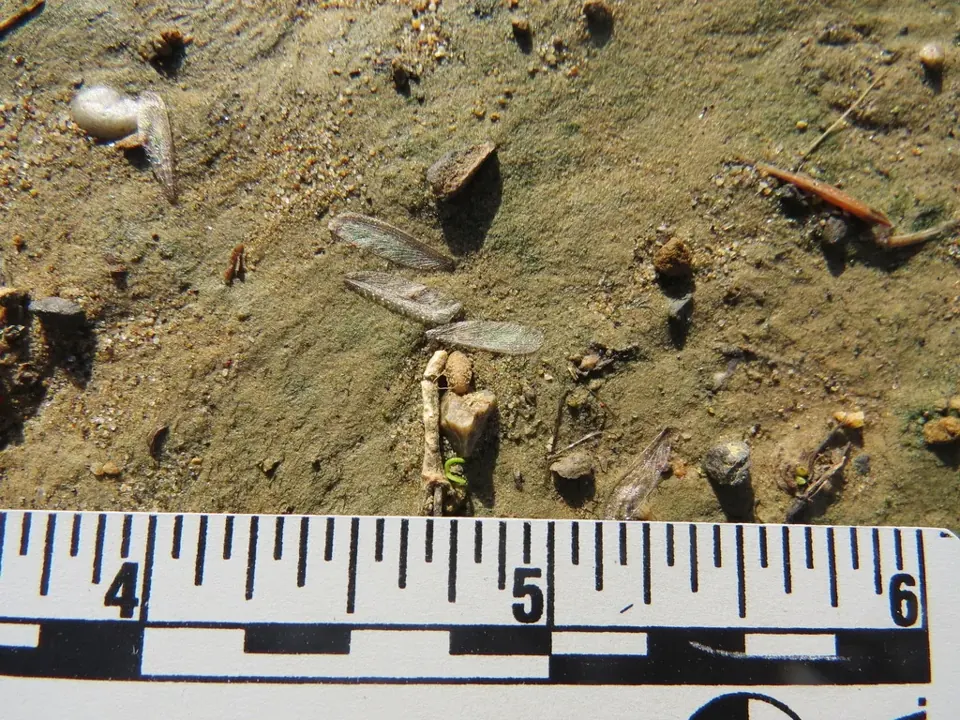
Drywood termite colonies are not connected to the ground 3, so there are no tubes to find. During a structural inspection, the inspector looks for feeding damage, shed wings, fecal pellets and kick-out holes smaller than 2 mm across 2.
Six-sided pellets are diagnostic for drywood termites, but pellets alone cannot show whether the colony is still active or how far it extends through the wood 2. UF/IFAS notes that drywood termites more commonly infest soffits and attics. They are also common in furniture 3.
Hidden drywood infestations can require removing walls, paneling or stucco, or working from ladders and scaffolds 2. That is why UC IPM considers judging the extent of a drywood infestation a job for an experienced professional 2.
Real estate inspections and WDI reports
In Texas, any official termite inspection must produce a State of Texas Wood Destroying Insect (WDI) report, a legal document that must be accurate and complete 1.
Inaccessible areas must be listed on the Texas form, along with any conditions conducive to termites 1. The inspector is not required to state how long the inspection remains valid, though some services guarantee their findings until a set date 1.
Rules differ between states. Some separate the annual renewal inspection from an inspection for a real estate transaction, and some require extra training for these inspections, recorded on the inspector's identification card 3.
For a buyer, the list of inaccessible areas deserves as much attention as the findings, since nothing in those areas was examined 1.
What a clean report does and does not show
A clean report means no termites or signs were found where the inspector could look. Mississippi State points out that a thoroughly inspected building can still harbor a hidden infestation 6. Its answer is preventive treatment combined with an annual inspection 6.
Keeping every report builds a record that matters later: NC State Extension notes that recently found damage cannot be dated without a reference point from an earlier inspection 7.
Dried mud in galleries with no termites present may be damage from an infestation that was controlled years ago 6. Mississippi State suggests scraping away old, inactive tubes completely once an infestation is controlled, so they cause no confusion on later inspections 6.
How often should a house be inspected?
Extension recommendations range from yearly to every few years, depending on risk:
- Every year: UF/IFAS recommends an annual renewal inspection by a trained, licensed inspector 3. University of Arizona extension recommends one even where no termites have been found 8.
- Every year, regardless of history, in Formosan areas: Mississippi State applies this to buildings in neighborhoods with Formosan termites 6.
- Every 3 to 5 years: UC IPM recommends regular inspections at this interval, and professional inspections every several years for homes with a termite history 4.
- More often: buildings that had no preventive treatment at construction 5.
Between professional visits, the University of Arizona suggests homeowners check the house themselves once or twice a year for signs of termites. Those signs include tubes, new holes in wood, pellets or sawdust that keep returning, and piles of wings near lights 9.
How to prepare for the visit
A little preparation lets the inspector reach more of the house and gives them better evidence to work with:
- Find the paperwork. NC State starts termite protection with an inspection and a look at the treatment history of the property 10. Have the last treatment record and any current contract ready.
- Save the insects. Collect swarmers or their wings so they can be identified 10. A small sealed container of rubbing alcohol keeps them intact 3.
- Photograph, then test. Photograph any tube, then break a section about an inch long and watch for termites or a repair over the next few days 6. For a pinhole, scrape away the mud, mark the spot and see whether it is sealed again 6.
- Clear the way. Move stored items away from garage and storage walls, where tubes hide 3. Clear the path to the crawl-space hatch, the attic access and the bath trap 1.
- Open the inspection space. Pull mulch back from the foundation and prune vegetation away from the walls 311.
Questions to ask the inspector
The report is more useful when these points are answered on it or in writing:
- Which termite group was found? Treatments differ drastically between groups, so identification comes first 3. If the group is uncertain, a specimen can go to a free extension lab.
- Is the activity current? Live termites mean an active infestation, while damage without termites may be old 6.
- Which areas could not be inspected, and why? The Texas WDI form must list them 1.
- Which conducive conditions were found? Wet soil, leaks, wood touching soil and disturbed treated soil all raise the risk 17.
For drywood work, UC IPM suggests getting at least three structural inspection reports before choosing among the termite treatment options 2.
Questions
What does a termite inspector look for?
The inspector looks for mud tubes, damaged or hollow-sounding wood, swarmers, shed wings, drywood pellets and kick-out holes 12. The report also notes conditions that invite termites, such as leaks, wood touching soil and wet soil against the foundation 1.
How often should a house be inspected for termites?
UF/IFAS recommends an annual renewal inspection by a trained, licensed inspector 3. UC IPM suggests regular inspections every 3 to 5 years 4. In areas with Formosan termites, Mississippi State calls for an annual inspection 6.
Is a termite inspection free?
Usually not. University of Arizona extension guidance tells homeowners to expect a fee for a professional termite inspection 8.
Does a clean termite inspection mean there are no termites?
It means no termites or signs were found in the areas the inspector could reach. Mississippi State notes that a thoroughly inspected building can still harbor hidden infestations, so it pairs inspection with preventive treatment and annual reinspection 6.
Should I break mud tubes before the inspection?
Photograph them first. Breaking a section about an inch long and watching for termites or a repair over the next few days shows whether a tube is active 6. An empty tube does not prove the termites are gone 7.
What is a WDI report?
WDI stands for wood-destroying insect. In Texas, an official termite inspection must produce a state WDI report, a legal document based on a visual inspection that notes inaccessible areas and conducive conditions 1.
Sources
- Gold, R. E., M. Keck, E. Brown, and K. Schofield. Formosan Subterranean Termites. Texas AgriLife Extension Service, E-367 (dated 9/10). extensionentomology.tamu.edu
- Lewis, V. R., A. M. Sutherland, and M. I. Haverty. Pest Notes: Drywood Termites. UC ANR Publication 7440. UC Statewide IPM Program. Updated 08/2014. ipm.ucanr.edu
- Oi, F. M., J. Davis, J. McConnell, J. Corbus, N. Nelson, and M. Atkinson. Termite Prevention and Control. UF/IFAS Extension ENY-2044 (IN1277). Original March 2020; revised December 2023. ask.ifas.ufl.edu
- Lewis, V. R., M. I. Haverty, and A. M. Sutherland. Pest Notes: Subterranean and Other Termites. UC ANR Publication 7415. UC Statewide IPM Program. Updated 05/2014. ipm.ucanr.edu
- Peterson, C., T. L. Wagner, J. E. Mulrooney, and T. G. Shelton. Subterranean Termites: Their Prevention and Control in Buildings. USDA Forest Service, Home and Garden Bulletin 64. Revised October 2006. research.fs.usda.gov
- Mississippi State University Extension Service, Dept. of Entomology. Signs of Termite Infestation. Year not stated. extension.msstate.edu
- Hayes, C. Monitoring and Management of Eastern Subterranean Termites. NC State Extension Publications. Publication date Jan. 22, 2025. content.ces.ncsu.edu
- Baker, P. Termite Management for Homeowners. University of Arizona Cooperative Extension AZ1356 (dated 3/2005). extension.arizona.edu
- Baker, P. B., and R. J. Marchosky, Jr. Arizona Termites of Economic Importance. University of Arizona Cooperative Extension AZ1369. June 2005. extension.arizona.edu
- Crawley, S., and C. C. Hayes. Termite Swarmers: What Do They Mean for You? NC State Extension Publications. Published Dec. 1, 2009; reviewed/revised Feb. 24, 2023. content.ces.ncsu.edu
- Texas A&M University, Urban and Structural Entomology Program. Native Subterranean Termites, Reticulitermes sp. (web page). Year not stated. urbanentomology.tamu.edu